Qatar has launched an emergency humanitarian air bridge to Venezuela following the devastating earthquakes that struck the country, acting on the directives of H.H. the Amir Sheikh Tamim bin Hamad Al Thani.
The mission includes the Qatari International Search and Rescue Group of the Internal Security Force (Lekhwiya), along with internationally certified rescue specialists, medical personnel, a fully equipped field hospital and advanced emergency equipment to support ongoing rescue and relief efforts.
The assistance comes as international teams race to help survivors after the powerful earthquakes caused widespread destruction across Venezuela. Qatar’s deployment is aimed at supporting search and rescue operations and providing urgent medical care to those affected.
The humanitarian mission reflects Qatar’s continued commitment to supporting countries affected by natural disasters through rapid emergency response and international cooperation.
Source: Qatar News Agency (QNA), Internal Security Force (Lekhwiya), H.E. Sheikh Khalifa bin Hamad Al Thani
تنفيذا لتوجيهات سيدي سمو الأمير المفدى، انطلق الجسر الجوي القطري إلى جمهورية فنزويلا البوليفارية الصديقة، وعلى متنه فريق من مجموعة البحث والإنقاذ القطرية الدولية التابعة لقوة الأمن الداخلي (لخويا)، إلى جانب مستشفيات ميدانية وفرق طبية ومساعدات إغاثية، دعما للجهود الدولية في إنقاذ… pic.twitter.com/745xcLAFkx
بناءً على توجيهات حضرة صاحب السمو الشيخ تميم بن حمد آل ثاني، أمير البلاد المفدى، انطلق الجسر الجوي القطري إلى جمهورية فنزويلا البوليفارية الصديقة، والذي يضم فريقًا من مجموعة البحث والإنقاذ القطرية الدولية التابعة لقوة الأمن الداخلي (لخويا)، دعمًا للجهود الدولية في إنقاذ المتضررين… pic.twitter.com/6YbwpYNGXj
Qatar Educational Vouchers 2026: MOEHE Reopens Applications, Income Limit Raised to QAR 35,000
The Ministry of Education and Higher Education in Qatar has reopened applications for educational vouchers through the Maarif public services portal. In a significant update that will benefit a larger number of Qatari families, the Ministry has also raised the maximum eligible monthly family income from QAR 25,000 to QAR 35,000, after deducting all financial obligations.
The announcement was made on June 25, 2026 and comes as part of the Ministry’s ongoing Corporate Social Responsibility project, implemented in cooperation with private schools and kindergartens across Qatar. The project currently provides more than 9,000 seats across four support categories, with approximately 2,400 of those seats specifically funded through educational vouchers.
For Qatari families who were previously just above the old income threshold, this update is directly relevant. If your household net income, meaning your salary after all financial obligations are deducted, falls at or below QAR 35,000 per month, you may now be eligible to apply.
If you are also navigating school options in Qatar more broadly, our complete guide to the best schools in Qatar 2026 covers private school options, fees, curriculums and admissions information for every type of family.
What Are Qatar’s Educational Vouchers?
The educational voucher program is a Ministry of Education initiative that allows eligible Qatari students to enrol in participating private schools and kindergartens without paying tuition fees out of pocket. Each voucher is valued at QAR 28,000 per year.
Here is the part that makes this particularly valuable: even if the private school’s annual fees are higher than QAR 28,000, the family does not pay the difference. The school owners cover the gap as their contribution to the Ministry’s Corporate Social Responsibility project. This means a child can attend a school that costs significantly more than QAR 28,000 per year without any additional financial burden on the family.
The program is designed to give eligible Qatari families genuine access to diverse, high-quality educational options that they might not otherwise be able to afford, promoting equal educational opportunity across the country.
Who Is Eligible for Educational Vouchers in Qatar?
Eligibility for the subsidized educational voucher seats is based on the following:
The applicant must be a Qatari national. The maximum actual monthly family income, after deducting all financial obligations, must not exceed QAR 35,000. This is the updated threshold announced on June 25, 2026, raised from the previous limit of QAR 25,000.
The phrase “actual family income” is important and the Ministry has specifically clarified what it means. It does not refer simply to the gross salary figure on an official payslip. It refers to the income that remains after all financial obligations, such as loans, commitments, and other monthly deductions, have been accounted for. Parents are required to submit their original payslip alongside supporting documents that prove their other financial obligations when submitting an application.
Children with special needs are also included in the program, with dedicated seats in the disability support category among the more than 9,000 total seats available.
The Four Categories of Support Under the CSR Project
The Ministry’s Corporate Social Responsibility project with private schools and kindergartens offers support across four distinct categories:
Fully free seats, which cover the entire cost of tuition with no family contribution required. Discounted seats, which offer a reduced tuition rate for eligible families. Seats for students with disabilities, specifically allocated to support children with special educational needs. Seats subsidized by educational vouchers, which is the category this application reopening relates to, covering approximately 2,400 seats across participating schools.
How to Apply for Educational Vouchers Through the Maarif Portal
Applications must be submitted electronically through the Maarif public services portal on the Ministry of Education and Higher Education’s official website. All required documents must be attached to complete the application and secure a seat.
Required documents include the original payslip and supporting documents proving all financial obligations. Additional documentation requirements may apply depending on individual circumstances, so checking the Maarif portal directly for the full and current list of requirements before submitting is strongly advised.
Given that the seats are limited and applications are now reopened following an update in eligibility, families who believe they qualify should apply promptly. Seats across all four support categories total more than 9,000, but demand is significant and availability will not remain open indefinitely.
How to apply: Visit the Maarif portal through the MOEHE official website and submit your application electronically with all required documents attached.
Why This Update Matters for Qatari Families
The decision to raise the income ceiling from QAR 25,000 to QAR 35,000 is a meaningful and practical change. Many Qatari families fall in the range between these two figures, either just above the old threshold or within the new one, and this update directly opens the program to a broader segment of the population.
Dr. Rania Mohammed, Director of the Private Schools and Kindergartens Department and Acting Director of the Private Schools Licensing Department at MOEHE, confirmed that the program continues to expand its support for eligible families and that the income threshold increase specifically aims to broaden the number of beneficiaries.
The value of the program itself, a QAR 28,000 annual voucher that covers fees even at schools that charge more than that amount, means the benefit is substantial for families who qualify. With private school fees in Qatar often running from QAR 30,000 to well over QAR 80,000 per year depending on the school and curriculum, access to this voucher can make a significant difference in which schools are realistically available to a family.
Frequently Asked Questions
What is the Qatar educational voucher program? It is a Ministry of Education and Higher Education initiative that provides eligible Qatari students with vouchers valued at QAR 28,000 to cover private school or kindergarten tuition fees, with no additional cost to the family even if the school fees exceed the voucher value.
Who can apply for educational vouchers in Qatar? Qatari nationals whose actual monthly family income, after deducting all financial obligations, does not exceed QAR 35,000 per month. Children with special needs also have dedicated seats available under the program.
What is the Maarif portal? Maarif is the Ministry of Education and Higher Education’s public services portal through which eligible families can submit applications for educational support including the voucher program.
How much is the educational voucher worth? Each educational voucher is valued at QAR 28,000 per year. If the school’s fees exceed this amount, the school covers the difference as part of the Ministry’s CSR project.
What documents are needed to apply? The original payslip and supporting documents proving financial obligations are required. Full document requirements are listed on the Maarif portal.
Why was the income limit raised? The Ministry raised the maximum monthly income threshold from QAR 25,000 to QAR 35,000 to broaden the number of eligible families and expand access to the program.
How many seats are available? The project provides more than 9,000 seats across four categories. Approximately 2,400 of those seats are funded by educational vouchers.
How do I apply? Through the Maarif public services portal on the Ministry of Education and Higher Education’s official website, attaching all required documents electronically.
Source: Qatar Ministry of Education and Higher Education (MOEHE), Qatar News Agency (QNA), June 25, 2026
Best Street Food in Qatar 2026: Traditional Dishes, Where to Eat and What to Order
Food is one of the best ways to understand any city, and in Doha that is truer than almost anywhere else. Qatar sits at a cultural crossroads where Arab, South Asian, Levantine and Persian food traditions have been layering on top of each other for generations, and what comes out of that mix is some of the most interesting, flavourful and underrated street food in the Middle East.
This is not the Qatar of fine dining and Michelin stars, though that exists too. This is the Qatar of steaming karak at midnight, of shawarma sliced straight off the spit at a counter you walk up to without a reservation, of luqaimat fresh out of the fryer from a woman at Souq Waqif, of samboosas so hot you have to blow on them before you bite. This is the real Qatar, and it tastes incredible.
Whether you are visiting for the World Cup, arriving as a new expat trying to figure out what to eat, or a long-term resident who wants a proper guide to all the traditional food of Qatar worth knowing about, this is the article. Every must-try dish with honest descriptions, specific places to go with names and locations, what to expect to pay, and how to work your way through Doha’s street food scene like someone who actually knows what they are doing.
Before anything else, before the food, before the shawarma, before any exploration of Qatar’s culinary landscape, you need a cup of karak. It is not optional. Karak is the social lubricant of this city, the reason every street corner has a tea shop, and quite possibly the most important beverage in Qatar’s daily life.
Karak is black tea brewed with milk, sugar, cardamom, and sometimes saffron and ginger, simmered until it is thick, sweet, and deeply aromatic. The result is a drink that is completely different from any cup of tea you have had before. It is rich without being heavy, sweet without being cloying, and warming in a way that somehow works even in summer.
It costs somewhere between QAR 1 and QAR 3 at most street-facing tea shops depending on the size and location, which makes it one of the best-value drinks in the city. You order it, you take it in a small plastic cup, you stand at the counter or sit on a plastic chair outside, and you understand immediately why people in Doha drink three or four of these a day.
Where to get the best karak in Doha: Chapati and Karak at Katara Cultural Village is the most famous dedicated karak spot in the city. Shay Al Shamoos at Souq Waqif is another institution with a devoted following. For a specialty tandoori karak, the Karak Stop at Mall of Qatar is worth the trip. Karaki at The Pearl and Chai Halib at Mall of Qatar are popular options for a slightly more polished setting.
Chapati and Poori: Karak’s Perfect Partner
Once you have your karak, you need something to eat with it, and in Qatar the answer is almost always chapati or poori. These are flatbreads that trace their roots back to the Indian subcontinent but have become completely embedded in Qatar’s food culture, served at every tea shop and karak counter across the city.
Chapati is thin and slightly chewy with a lightly charred surface. Poori puffs up when it hits the oil, giving it a crispy, airy texture that is genuinely addictive. Both can be eaten plain or rolled around fillings ranging from savoury options like spiced mince and cheese to sweet combinations like honey and Nutella. Eaten fresh off the griddle with a cup of karak in hand, this is one of the best cheap meals in Qatar, often costing just a few riyals.
Where to eat: Chapati and Karak at Katara is the obvious first stop. Shay Al Shamoos at Souq Waqif does excellent versions as well. Most local karak shops and Indian-run tea houses across Doha serve some variation of this pairing.
Shawarma: The King of Qatar’s Street Food Scene
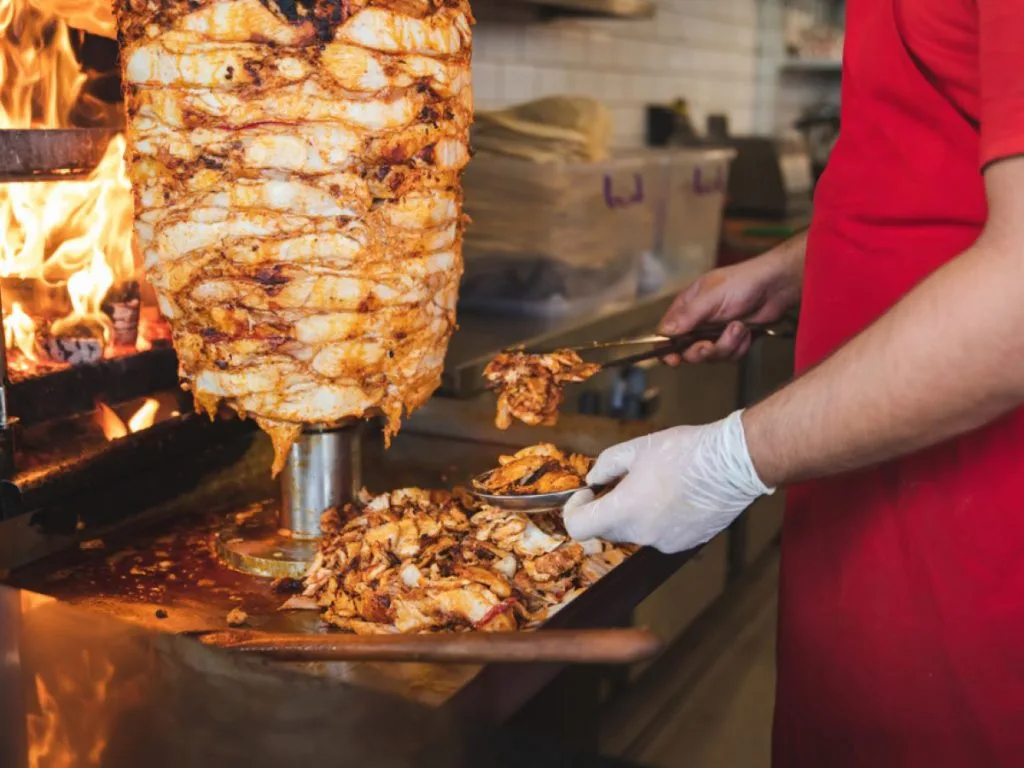
If there is one dish that represents street food across the entire Middle East, it is shawarma, and Qatar does it exceptionally well. The basic concept is simple: boneless strips of chicken or beef are layered and marinated, then stacked and slow-roasted on a vertical rotating spit. As the meat cooks, the outer layer crisps up and gets sliced thin, then wrapped in bread with garlic sauce, pickles, tomatoes and sometimes fries tucked inside.
The execution, though, varies enormously. Lebanese shawarma comes in thin pita with a heavy hand of toum garlic sauce. Syrian versions lean toward thicker wraps with more vegetables. The Turkish style uses slightly different spicing. The generic “Arabic” version, which is what you find most commonly in Qatar, is usually wrapped in soft khubz bread and is deeply satisfying in a way that is hard to articulate without just eating one.
A good shawarma in Doha costs between QAR 5 and QAR 15 depending on where you go and what goes in it. It is a perfect late-night option because shawarma shops stay open very late, sometimes through the night.
Where to eat the best shawarma in Doha: Mashawi Al Arabi in the Old Airport area is one of the most recommended spots among long-term residents for an authentic and properly made shawarma. Jabal Lebnan on Al Nasr Street is another institution with consistent quality. Al Bisana in Katara is a reliable option if you are already in that part of the city. Petra has multiple locations across Doha and is a go-to for many residents.
Falafel: The Best Vegan Street Food in Qatar
Falafel is one of those foods that sounds simple but is absolutely devastating when made well and genuinely disappointing when done badly. The good news is that in Doha, it is almost always made well.
The Qatar and Levantine style of falafel uses ground chickpeas, fava beans, or a combination of both, mixed with garlic, parsley, coriander and spices, then shaped into small balls or flat discs and deep-fried until the outside is crackly and golden and the inside is soft and vivid green. Eat it plain, stuff it into pita with tahini sauce, pickles and fresh salad, or order a falafel platter as part of a larger spread.
It is a brilliant breakfast option, a perfect quick snack, and completely plant-based, making it one of the most accessible dishes in Qatar for every type of eater. Price-wise, falafel in Doha is among the most affordable bites you can find, usually between QAR 3 and QAR 10 depending on portion size.
Where to eat the best falafel in Doha: Falafel AlAkawi is one of the dedicated falafel chains in Qatar worth knowing about. Zater wa Zeit has locations around Doha and does excellent versions. Layali Al Qahira while wandering around the souq area is a good local option. For something slightly more elevated, Khan Farouk and Ard Canaan in Katara both serve stuffed and baked falafel variations that are worth the extra few riyals.
Samboosa: The Snack That Goes With Everything
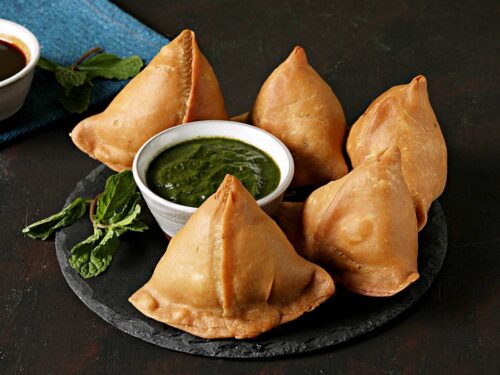
Samboosa is Qatar’s version of the universal fried dumpling that exists in some form across almost every food culture in the world. Here it takes the form of small triangular pastries with thin, crispy shells stuffed with spiced minced meat, spinach, cheese, or a combination of all three. They are deep-fried until the pastry is shatteringly crisp, then served hot with chutney or yoghurt dipping sauce on the side.
They are enormously popular during Ramadan, when breaking the fast with a samboosa and karak is a near-universal tradition, but they are available year-round across Doha at bakeries, tea shops and restaurant starters menus. A small bag of samboosas costs almost nothing, which is part of why they are so beloved.
Where to eat the best samboosa in Doha: Delhi Bakery in Doha Jadeeda is one of the most reliable spots for consistently good samboosas throughout the day. Soghaat on Salwa Road is another popular option. For a slightly more refined version, the chicken samosas at the Spice Market at W Doha Hotel are worth the step up in price.
Ragag: The Traditional Qatar Crepe You Have Never Heard Of
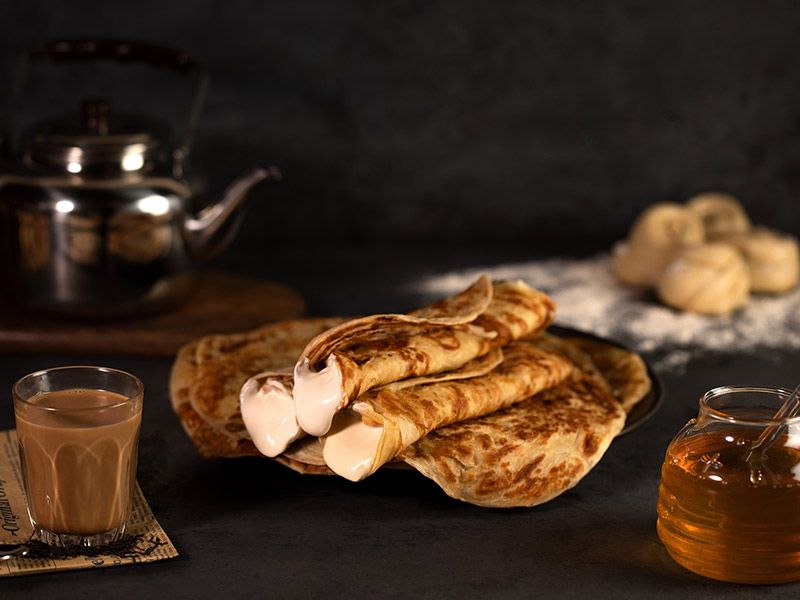
Ragag is the one on this list that most visitors miss entirely, which is a genuine shame because it is one of the most interesting and distinctly Qatari street foods you can find. Paper-thin and crispy, folded into a cone or rolled flat, ragag has a wafer-like texture that is completely different from either a Western crepe or a South Asian roti. It is eaten hot, either plain with tea, wrapped around kebabs, or topped with fillings like cheese, eggs, honey, or mhyawa, a traditional thick fish paste that is spread directly onto the bread as it cooks.
The experience of eating ragag, particularly at Souq Waqif where local women set up stalls and cook it fresh in front of you, is one of those moments in Doha that stays with you. It is genuine, it is traditional, it is cheap, and it is very, very good.
Where to eat ragag: The central square at Souq Waqif is the most authentic place to try ragag in Qatar, where local women cook and sell it fresh at their stalls. Shay Al Shamoos at Souq Waqif also serves what many consider the best rigag in the city.
Luqaimat: The Sweet Street Food You Cannot Eat Just One Of
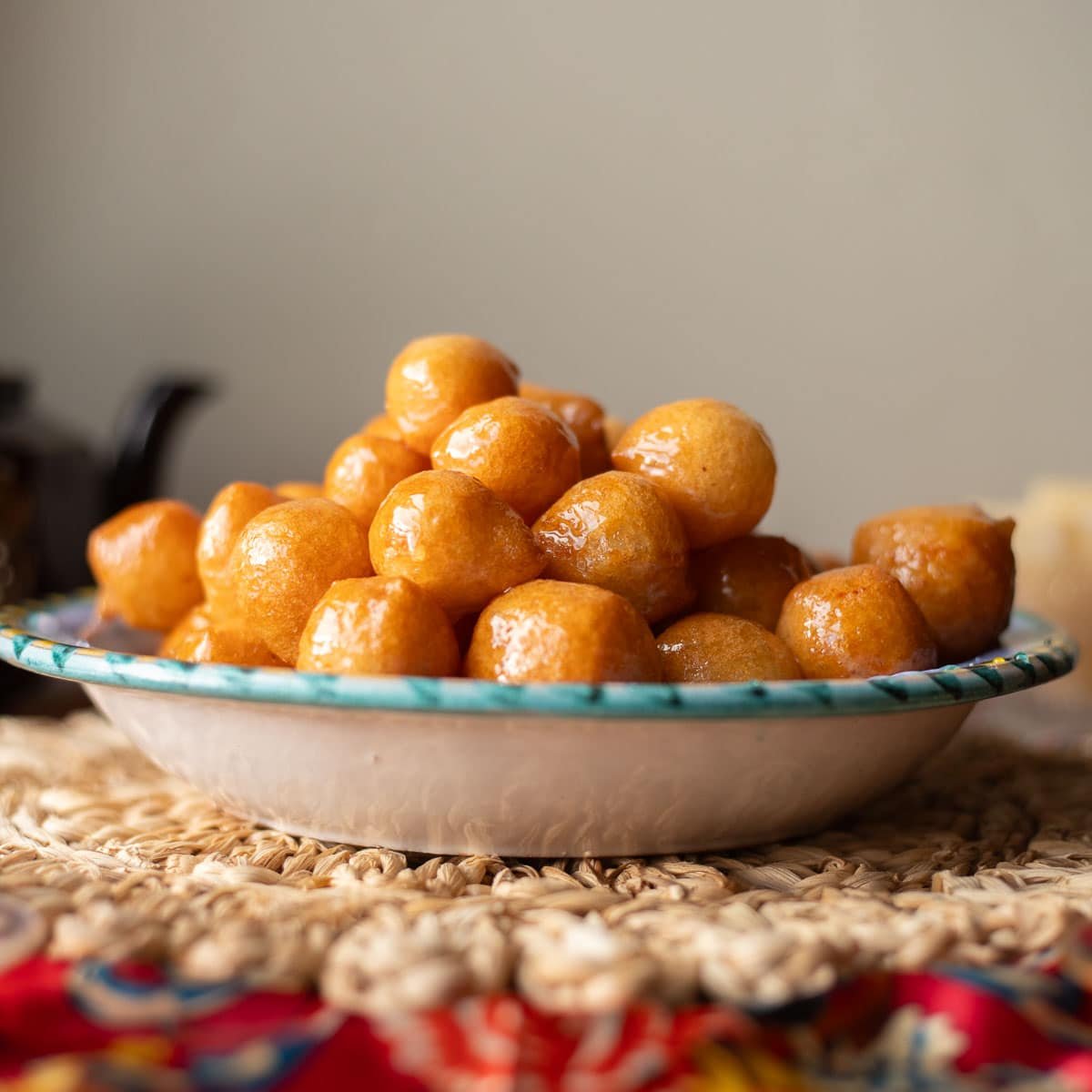
Luqaimat are sweet flour dumplings, round and about the size of a large marble, that come out of the fryer with a golden, slightly crispy shell and a warm, soft, almost gooey centre. They get soaked in date syrup or sugar syrup and are flavoured with cardamom and saffron, which gives them a warmth and fragrance that makes them completely impossible to stop eating.
They are a Ramadan staple, sold everywhere during iftar, but they are available year-round at karak shops and traditional sweet stalls. The absolute non-negotiable rule with luqaimat is that they must be eaten immediately while they are still hot and fresh. A cold luqaimat is a sad luqaimat.
Price-wise, a serving of luqaimat in Doha is genuinely affordable, usually between QAR 5 and QAR 15 depending on size and location.
Where to eat luqaimat: Local women selling homecooked foods at Souq Waqif are the most authentic source and the most fun experience. Karaki at The Pearl and Chai Halib at Mall of Qatar both serve good luqaimat in a slightly more accessible setting.
Harees: Qatar’s Most Comforting Traditional Food
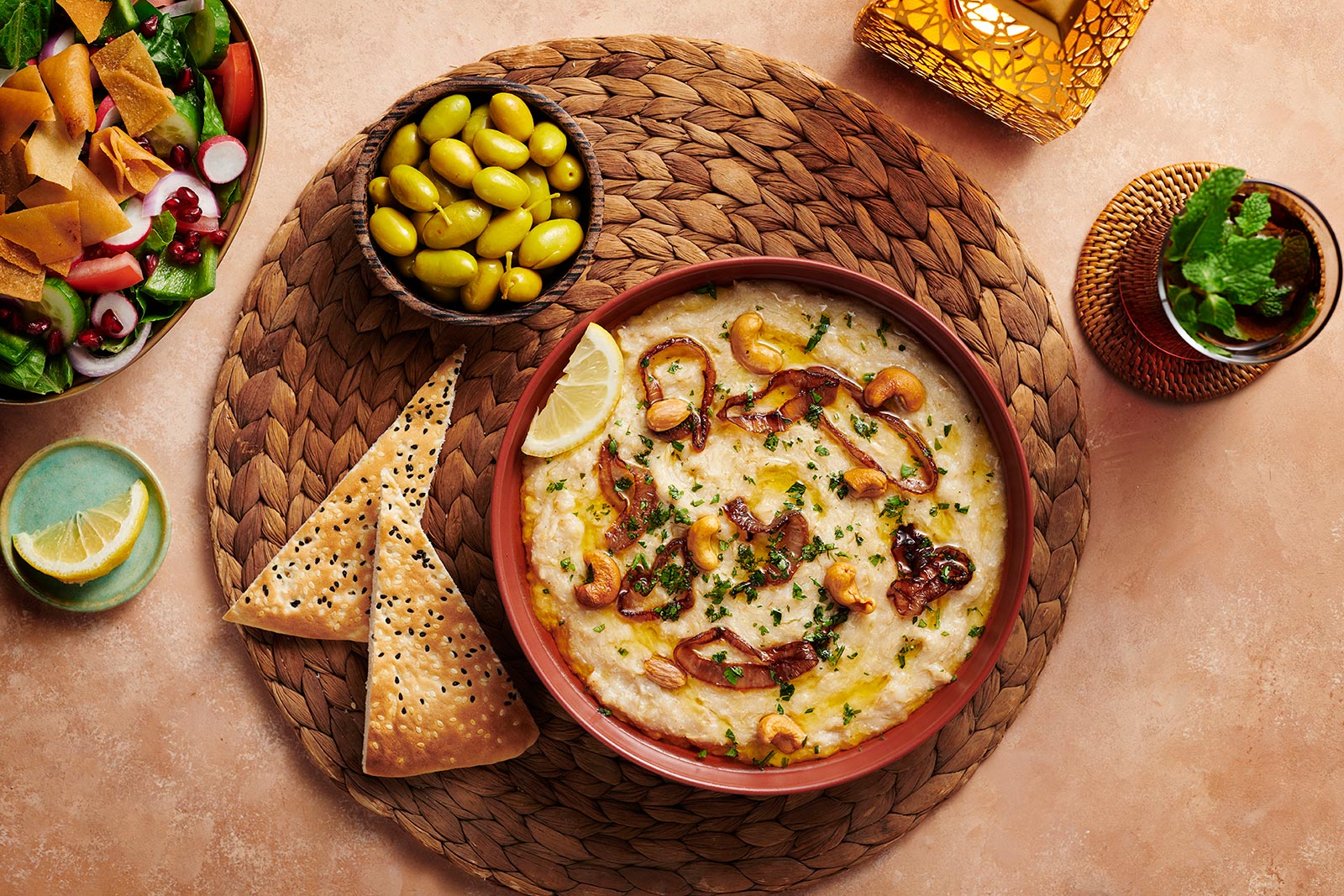
Harees is the dish that most visitors to Qatar never try and most long-term expats discover during Ramadan and then cannot stop thinking about. It is slow-cooked wheat and meat, usually chicken or lamb, simmered together for hours until they become a thick, porridge-like consistency seasoned with salt, pepper, and sometimes a drizzle of ghee on top.
It sounds simple and it is, which is exactly why it works. Harees is deeply satisfying comfort food in the truest sense, the kind of dish that feels like it has been feeding people for centuries, which it essentially has. It is a staple of Qatari traditional cuisine and one of the most important dishes in the local food culture.
Where to eat harees: Souq Waqif has several spots that serve harees, particularly during Ramadan. Select traditional Qatari restaurants in Doha serve it year-round.
Knafeh: The Street Dessert Worth Going Out of Your Way For
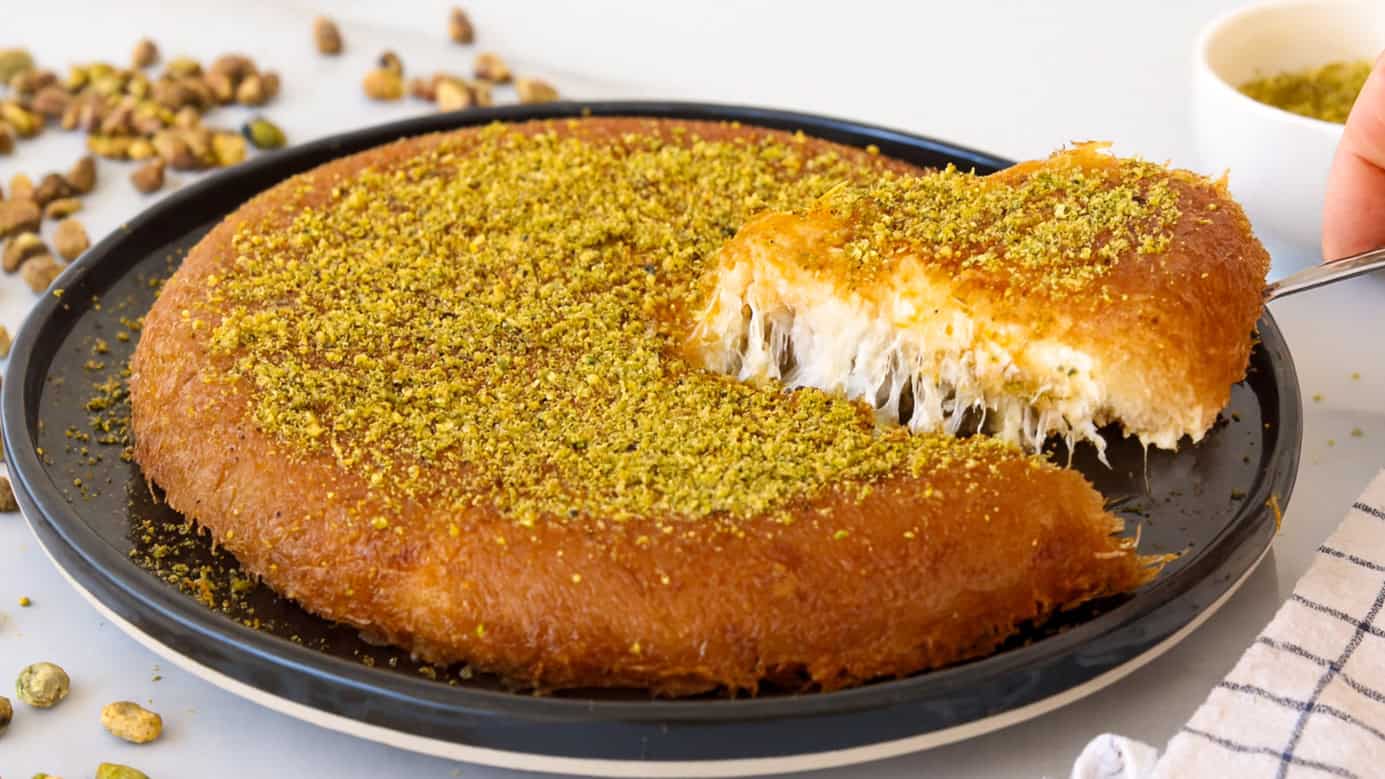
Knafeh is the dessert version of the street food experience in Qatar and it deserves its own mention. Layers of shredded pastry or fine semolina are packed around a filling of soft white cheese, baked until golden and crispy, then soaked in fragrant sugar syrup and finished with crushed pistachios on top. It is sweet, it is rich, it is slightly salty from the cheese, and it is best eaten warm directly from the tray.
Where to eat knafeh: Multiple sweet shops around Doha serve knafeh, particularly in areas with strong Levantine community presence. Souq Waqif has several options worth exploring.
Pani Puri: The Indian Street Snack that Doha Loves
Qatar’s large South Asian community has brought pani puri firmly into the mainstream Doha street food consciousness. These are small, hollow, crispy spheres that you fill with a mixture of spiced potato, chickpeas and tamarind chutney, then flood with tangy, spiced water and pop into your mouth whole. The combination of textures and the explosion of flavour is genuinely like nothing else you can eat.
Where to eat: Old Mumbai Ice Cream at Family Food Centre on Old Airport Road is one of the spots most associated with South Asian street snacks in Doha. Indian and Asian grocery areas, particularly around the Old Airport Road area, have several stalls and small restaurants serving authentic pani puri.
Where to Find the Best Street Food in Doha
Souq Waqif
Souq Waqif is the single best place in Qatar to eat street food, full stop. The winding alleyways lined with spice shops, traditional restaurants and food stalls, the smell of grilling meat mixing with incense and freshly baked bread, the energy of the place in the evenings particularly, all of it makes Souq Waqif the most important food destination in the city for anyone who wants to understand what Qatar actually tastes like. Ragag stalls, karak shops, shawarma counters, knafeh trays, falafel spots and luqaimat vendors are all concentrated here. Go hungry, go in the evening, and plan to wander rather than stick to a list.
Old Airport Road Area
The Old Airport Road and its surrounding streets in Doha Jadeeda is where you find some of the most authentic and affordable Indian, Pakistani and Levantine food in the country. This is where long-term expats from South Asia and the Middle East shop and eat, which means the food is made the way it is actually supposed to be made rather than adjusted for a tourist audience. Shawarma spots, samboosa bakeries, karak shops and South Asian snack stalls all cluster here.
Al Wakrah Market
If you want a local market experience that is significantly less touristy than Souq Waqif, Al Wakrah market is the place. It has a genuinely local atmosphere and a good range of traditional food options, fresh fish from the nearby coast, and a relaxed pace that makes it perfect for an afternoon exploration.
Doha Corniche
The Corniche is less about the food stalls and more about the experience of eating while looking at one of the most beautiful waterfronts in the region. There are food trucks and informal vendors particularly in the evenings, and the combination of the Doha skyline view across the water with a cup of karak and some street snacks is hard to beat.
Box Parks and Container Cafes
Qatar’s local interpretation of street food culture often takes the form of refurbished shipping container parks, which house karak shops, specialty coffee spots, and quick-bite food stalls in a casual outdoor setting. These are spread across various parts of Doha and are particularly popular in the evenings among younger residents.
Frequently Asked Questions
What is the traditional food of Qatar? Qatar’s traditional cuisine includes machboos (spiced rice with meat or fish), harees (slow-cooked wheat and meat), thareed (bread and meat stew), balaleet (sweet vermicelli with eggs), luqaimat (sweet fried dumplings), ragag (thin crispy crepes), samboosa, and dates with Arabic coffee which is served as a symbol of hospitality.
What is the best street food in Doha? Shawarma, karak tea with chapati, falafel, samboosa, luqaimat and ragag are the most recommended street foods in Doha. Souq Waqif is the best single location to try all of them in one visit.
Where can I find affordable restaurants in Doha? The Old Airport Road area has the most concentration of affordable and genuinely good restaurants in Doha. Souq Waqif also has options across a wide price range. For a full guide see our affordable Doha eating guide on People and Qatar.
How much does street food cost in Qatar? Street food in Qatar is very affordable. Karak tea costs QAR 1 to QAR 3, chapati a few riyals, shawarma between QAR 5 and QAR 15, falafel from QAR 3 to QAR 10, samboosa from QAR 2 to QAR 5 per piece, and luqaimat between QAR 5 and QAR 15 per serving.
Is there vegetarian street food in Qatar? Yes. Falafel, samboosa with cheese or vegetable filling, ragag with cheese or honey, luqaimat, pani puri, and knafeh are all vegetarian options widely available across Doha.
Where is the best place for street food in Qatar? Souq Waqif is the most concentrated and atmospheric location for street food in Qatar. The Old Airport Road area is the best for affordable South Asian and Levantine street food. Al Wakrah Market offers a more local, less touristy experience.
Arabic music fans in Qatar have a big night to look forward to this autumn. Angham is coming to Doha on October 16, 2026, for a one-night live concert at Al Mayassa Theatre, QNCC.
The Egyptian star will perform in Doha at 9pm, with doors opening at 8pm, for what is expected to be one of the biggest Arabic concerts in Qatar this season. Tickets for Angham live in Doha are already on sale, with prices starting from QAR 450.
Qatar Toy Festival 2026: Tickets, Dates, Celebrity Schedule, Summer Camp and Everything You Need to Know
The Qatar Toy Festival is back for its fourth edition and it is the biggest one yet. Running from July 1 to July 31, 2026 at the Doha Exhibition and Convention Center, this is the summer event that families across Qatar have been waiting for, and this year the scale, the celebrity line-up, and the range of zones and experiences are genuinely unlike anything the festival has delivered before.
This is the complete guide for families planning to visit. Ticket prices in QAR for every category, the full celebrity appearance schedule with dates, a breakdown of every zone and what is inside each one, the Summer Camp program for kids including fees and how to book, timings for weekdays and weekends, how to get there, and where to buy tickets online right now.
Whether you are trying to plan one visit or figure out how to space out multiple trips to catch different celebrities, everything you need is right here.
For more things to do with family in Doha this summer, check our Doha Summer Survival Guide 2026 which covers every major event, activity and experience happening across the city.
Qatar Toy Festival 2026: Key Details
Dates: July 1 to July 31, 2026 Venue: Doha Exhibition and Convention Center (DECC), West Bay, Doha Timings: Weekdays (Sunday to Wednesday) 2 PM to 10 PM, Weekends (Thursday to Saturday) 2 PM to 11 PM Instagram: @qatartoyfestival Tickets: Available through Virgin Megastore Qatar, Snoonu, Platinum List and Q-Tickets
Qatar Toy Festival 2026 Ticket Prices: Every Category Explained
Daily tickets are limited, so booking in advance is strongly recommended. Here is every ticket type with full details on what is included.
Entry Ticket QAR 50 on weekdays, QAR 70 on weekends. Allows entrance for one person for one day. Grants access to all Qatar Toy Festival activities and stage shows, excluding PUBG Mobile, Poppy Playtime, Football, Hot Wheels and Pac-Man experiences.
Ultimate Fun Ticket QAR 80. Allows entrance for one person for one day. Grants access to all Qatar Toy Festival activities and stage shows including PUBG Mobile, Poppy Playtime, Football, Hot Wheels and Pac-Man.
Family Entry Ticket QAR 200 on weekdays, QAR 280 on weekends. Five people for the price of four, for one day. Grants access to all activities and stage shows, excluding the premium experiences listed above.
Fast Track Ticket QAR 300. Allows entrance for one person for one day. Includes all activities and premium experiences plus fast-track access to all activity queues.
VVIP Ticket QAR 1,500 for four people for one day. Includes all activities, premium experiences (PUBG, Horror House, Sherlock Holmes), VVIP lounge with catering, exclusive Meet and Greet with selected characters in the VVIP Lounge, and fast-track access to all queues.
Free entry: Children under one year old do not need a ticket. Children with special needs enter free with a valid ID card.
Celebrity Appearances at Qatar Toy Festival 2026: Full Schedule
This year’s celebrity line-up is one of the biggest draws of the festival. Each appearance is on a specific date, so planning your visit around the celebrity your kids love most is very much worth doing. All stage show appearances are first come, first served at the stage area.
July 1: ALJ Sisters, live on stage during the opening ceremony at 6:30 PM
July 2 to 3: Adnan Family, Meet and Greet on stage at 8:15 PM
July 4 to 6: Dreams show featuring Adel and Bobo, written and directed by Duaij Al-Khamees with songs by Abdullah Khaled
July 14 to 15: Tarek and Mohammad Tourgane
July 16, 17 and 18: Emilia Jaber
July 20 to 21: Abir Alsaghir
July 22 to 23: Abo Flah
July 24 to 25: Ahmad Khateb and Bilal Fadili
July 26 to 27: Omar Abdelrahman
Coming soon (dates to be announced): Rasha Rizk and Emy Hetari
Follow @qatartoyfestival on Instagram for daily updates on celebrity schedules, new announcements and surprise reveals throughout the month.
What Is Inside Qatar Toy Festival 2026: Every Zone Explained
The festival is organised across five distinct islands, with almost 30 entertainment corners, 10 retail stores and more than 50 international brands represented across the venue.
Youth Zone The action-packed area for older kids and teens, featuring PUBG Mobile, Poppy Playtime, and other adrenaline-first experiences. This zone also includes the Sherlock Holmes Escape Room and the chilling Friday Night at Freddy’s world, both of which are new additions for 2026.
Champions Land Inspired by thrilling competitive worlds, Champions Land features Hot Wheels, Pac-Man, and other brand-driven entertainment corners built around games and competition.
The Studios A brand-new zone for 2026 built for everyone across all ages, featuring The Flintstones, Mickey Mouse, and other classic character worlds. This is one of the most anticipated new additions to the festival this year.
Fancy Land Dedicated to girls and younger visitors, Fancy Land brings magical moments with Lilo and Stitch, Disney Princess, Frozen, and more. The Lilo and Stitch corner is a first for the festival in 2026.
Cutie Pie Land Designed for the youngest visitors, Cutie Pie Land features Paw Patrol, Jmal-Jmal, and other toddler and young child favourites with experiences scaled to smaller guests.
Shopping at Qatar Toy Festival The exclusive shopping experience at the festival is genuinely worth making time for. Highlights in 2026 include limited-edition Labubu merchandise, a Haribo truck, and stores carrying souvenirs and products from the worlds featured across the festival zones.
The Opening Ceremony: July 1
The festival kicks off on July 1 with a full opening ceremony featuring music, mascots, surprise flash mobs and a first look at everything inside the venue. ALJ Sisters will perform live on stage at 6:30 PM during the opening. There is also the highly anticipated chicken competition that has been teased for this year’s edition. Arriving early on opening day is recommended.
Back-to-School Exhibition: Last Week of July
During the final week of the festival, Qatar Toy Festival will host a Back-to-School exhibition with special promotions, educational stage shows and creative competitions. The School Bus Zone lets kids customise their backpacks, pencil cases, water bottles and stationery with stickers, markers and keychains, making it a genuinely useful way to round out the summer before the school year begins.
Qatar Toy Festival Summer Camp 2026: Full Details
The Summer Camp at Qatar Toy Festival is running for its second year and is one of the most popular additions to the festival program. It is separate from the general festival entry and runs on a different schedule.
Dates: July 5 to July 30, 2026 (excluding Fridays and Saturdays) Timings: Sunday to Thursday, 8 AM to 1 PM Location: Qatar Toy Festival venue, DECC Ages: Children aged 4 to 12 (divided into age groups) Capacity: Limited to 150 children per session. Book early.
Fees: Weekly: QAR 750 Monthly: QAR 2,000
What the camp covers week by week:
Week 1 focuses on foundational science and technology skills, with children working toward presenting their own Eco Solution.
Week 2 builds foundational physics and engineering skills, with a hands-on challenge where children optimise and present their own functional STEM creation.
Week 3 develops forensics and logic skills, with teams working to crack a code and present their final case solution.
Week 4 focuses on design and research skills, concluding with children presenting their original ideas at the Science Street Mini Expo.
Each child receives prizes and a personalised certificate at the end of their camp session. The camp is designed and delivered by Science Street.
By car: The DECC is located in West Bay, Doha. GPS navigation to the Doha Exhibition and Convention Center is advised. Heading northwest on Al Corniche, turn left onto Al Funduq Street, continue toward Omar Al Mukhtar Street, then follow Hayr Al Harba with the destination appearing on the right.
By metro: Take the Red Line to Al Qassar station, followed by approximately a 19-minute walk to the DECC.
By taxi or ride-hailing: Uber and Karwa are both available and can drop directly at the DECC entrance.
Frequently Asked Questions
What are the Qatar Toy Festival 2026 dates? July 1 to July 31, 2026 at DECC, West Bay, Doha.
What are the Qatar Toy Festival 2026 ticket prices? Entry Ticket from QAR 50 on weekdays and QAR 70 on weekends. Ultimate Fun Ticket QAR 80. Family Ticket from QAR 200 on weekdays. Fast Track QAR 300. VVIP QAR 1,500 for four people.
What are the timings for Qatar Toy Festival 2026? Weekdays (Sunday to Wednesday) 2 PM to 10 PM. Weekends (Thursday to Saturday) 2 PM to 11 PM.
Where is Qatar Toy Festival 2026? Doha Exhibition and Convention Center (DECC), West Bay, Doha, Qatar.
How much is the Summer Camp at Qatar Toy Festival? QAR 750 per week or QAR 2,000 for the full month. For children aged 4 to 12, running Sunday to Thursday from 8 AM to 1 PM. Contact: +974 51262710.
Which celebrities are appearing at Qatar Toy Festival 2026? ALJ Sisters (July 1), Adnan Family (July 2 to 3), Emilia Jaber (July 16 to 18), Abir Alsaghir (July 20 to 21), Abo Flah (July 22 to 23), Ahmad Khateb and Bilal Fadili (July 24 to 25), Omar Abdelrahman (July 26 to 27), with Rasha Rizk and Emy Hetari dates to be announced.
Do children under one need a ticket? No. Children under one year old enter free. Children with special needs also enter free with a valid ID card.
Where can I buy Qatar Toy Festival 2026 tickets? Through Virgin Megastore Qatar, Snoonu, Platinum List and Q-Tickets. Links are listed above in this article.
Is Qatar Toy Festival suitable for all ages? Yes. The festival is designed as a multi-generational destination with zones for toddlers, young children, pre-teens and teens, and adults.
Can I bring food from outside? No. Food and beverages from outside the festival are not permitted inside the venue.
Note: The details mentioned in this event listing are sourced from the organizers’ official announcements and are subject to change. Please check with the organizer directly before making plans.
Max Amini Qatar 2026: Max Amini Live in Doha Officially Announced
Comedy fans in Qatar have something to celebrate. Max Amini Live in Doha has now been officially announced, giving audiences the chance to see the internationally acclaimed comedian perform live in Qatar.
While the event date has not yet been revealed, pre-registration is now open, allowing fans to be among the first to access tickets when sales begin.
Max Amini Live in Doha Confirmed
After weeks of speculation, Max Amini is officially bringing his stand-up comedy show to Doha.
The comedian, known for his sharp observations, relatable storytelling, and energetic performances, will take the stage for a one-night-only live performance in Qatar.
Whether you’re a longtime fan or seeing him perform for the first time, this promises to be one of Doha’s biggest comedy events of 2026.
Pre-Register for Max Amini Doha Tickets
Fans can now pre-register to receive priority access when tickets officially go on sale.
Pre-registering gives you the opportunity to be among the first to purchase tickets once sales open.
What to Expect
Max Amini has built a global fanbase with his signature mix of observational comedy, cultural humor, and hilarious stories about family, relationships, and everyday life.
His live performances are known for:
Interactive audience moments
Clever storytelling
Fast-paced stand-up comedy
A fun atmosphere for audiences of all backgrounds
Expect an evening filled with laughter, great energy, and unforgettable moments.
Event Details
Event: Max Amini Live in Doha
Location: Doha, Qatar
Status: Officially announced
Registration: Open now
Tickets: Coming soon
When Do Tickets Go on Sale?
Ticket sales have not yet opened, but fans can already secure early access by pre-registering through the official event page.
The official event listing will also announce:
Show date
Venue
Ticket prices
On-sale date
Entry timings
Age requirements
Max Amini Qatar 2026 Latest Update
Max Amini Live in Doha is now officially confirmed. While the event date and ticket sale details are still to be announced, pre-registration is now live for fans who want the first opportunity to buy tickets.
If you’re planning to attend, it’s worth registering early, as this one-night-only comedy event is expected to attract strong demand.
Save this link and follow People & Qatar for the update.
Best Hospitals in Qatar 2026: HMC vs Sidra vs Private Hospitals in Doha
If you are searching for the best hospitals in Qatar, the answer depends on what you actually need. For major emergencies, trauma care, cancer treatment and advanced public healthcare, Hamad Medical Corporation (HMC) remains the backbone of Qatar’s hospital system. For women’s health, pediatrics and highly specialized family care, Sidra Medicine is one of the country’s standout hospitals. And if you want faster appointments, private rooms, direct insurance billing and premium service, several private hospitals in Doha are strong options.
So if you are wondering whether to choose HMC vs Sidra vs a private hospital in Qatar, here is the short answer:
Choose HMC for emergency care, trauma, major public specialist care and broad hospital access across Qatar
Choose Sidra Medicine for women’s health, children’s care and certain highly specialized family services
Choose a private hospital in Doha if you want faster access, elective care, convenience, private consultations or premium hospital facilities
Quick answer: which is the best hospital in Qatar?
There is no single best hospital for every patient. The best choice depends on the specialty:
Best public hospital network in Qatar: Hamad Medical Corporation (HMC)
Best hospital in Qatar for women and children: Sidra Medicine
Best hospital in Qatar for sports injuries and orthopedics: Aspetar
Best for premium private care in Doha: The View Hospital, Aman Hospital, Al-Ahli Hospital, Doha Clinic Hospital, Aster Hospital and others depending on your budget, insurance and required specialty
HMC vs Sidra vs private hospitals in Qatar
1) HMC: best for emergency, trauma and major public healthcare in Qatar
If you ask most residents where to go for serious emergency care in Qatar, the answer is usually Hamad Medical Corporation.
HMC is Qatar’s main public healthcare provider and runs a large hospital network, including Hamad General Hospital, specialist hospitals and major emergency services. Hamad General Hospital is one of the country’s biggest and most important hospitals, with emergency medicine, trauma care, intensive care, surgery and a long list of specialist clinics.
HMC is usually the best fit for:
Major emergencies
Trauma and accident cases
Complex public specialist care
Heart, cancer and other government specialist referrals
Residents using Qatar’s public healthcare system
Best known HMC hospitals and centres include:
Hamad General Hospital
Heart Hospital
National Center for Cancer Care and Research
Women’s Wellness and Research Center
Al Wakra Hospital
Hazm Mebaireek General Hospital
2) Sidra Medicine: best for women’s health and pediatric care
If your search is about the best hospital in Qatar for pregnancy, childbirth, gynecology, pediatrics or children’s specialist care, Sidra Medicine should be high on your list.
Sidra is one of Qatar’s best-known hospitals for women, children and young people, and it has built a strong reputation for specialized care, advanced technology and a modern patient experience. It is also one of the most recognizable hospital campuses in Doha.
Sidra Medicine is a top choice for:
Pediatrics and children’s specialist care
Women’s health and gynecology
Pregnancy and maternity-related specialist services
Family-focused private care
Patients looking for a highly modern hospital environment
3) Private hospitals in Qatar: best for speed, convenience and premium care
Private hospitals are often the best option if you want faster appointments, specialist consultations without the public system, easier scheduling and a more premium patient experience.
Some of the most searched private hospitals in Qatar include:
The View Hospital
Aman Hospital
Al-Ahli Hospital
Doha Clinic Hospital
Aster Hospital
Turkish Hospital
Al Emadi Hospital
American Hospital Clinics
The Pearl International Hospital
These hospitals vary by specialty, price point, insurance coverage and location, so the best one for you depends on whether you need maternity care, surgery, family medicine, orthopedics, pediatrics, executive health checks or outpatient treatment.
Best hospitals in Qatar by specialty
Best hospital in Qatar for emergencies
For major emergencies, HMC hospitals remain the most important option in the country, especially Hamad General Hospital and other HMC emergency facilities.
Best hospital in Qatar for women and children
Sidra Medicine is one of the strongest choices in Qatar for women’s health, pediatrics and child-focused specialist care.
Best hospital in Qatar for sports injuries and orthopedics
Aspetar is the standout name in Qatar for sports medicine, rehabilitation, orthopedic treatment and athlete care. It is one of the most recognized specialist sports hospitals in the region.
Best private hospitals in Doha
If you are specifically looking for private hospitals in Doha, the names that come up most often include:
The View Hospital for premium care and advanced technology
Aman Hospital for high-end private healthcare
Al-Ahli Hospital for a broad range of specialties
Doha Clinic Hospital for established private care in Doha
Aster Hospital for accessible everyday private healthcare and consultations
Top hospitals in Qatar to know in 2026
Here are the hospitals most people in Qatar should know about:
Public and specialist hospitals
Hamad General Hospital
Sidra Medicine
Aspetar
National Center for Cancer Care and Research
Heart Hospital
Al Wakra Hospital
Private hospitals
The View Hospital
Aman Hospital
Al-Ahli Hospital
Doha Clinic Hospital
Aster Hospital
Turkish Hospital
Al Emadi Hospital
So, which hospital should you actually choose in Qatar?
Here is the simplest way to decide:
Go to HMC if it is an emergency, a major public referral, trauma case or complex government specialist case
Choose Sidra Medicine if the patient is a woman, child or young person needing specialized care
Choose Aspetar for sports injuries, rehab and orthopedic sports medicine
Choose a private hospital in Doha if you want speed, comfort, elective treatment, private consultations or easier appointment booking
For most people searching best hospitals in Qatar, the real answer is not one hospital but the right hospital for the right need.
HMC is the core of Qatar’s public hospital system and the strongest option for many serious and emergency cases
Sidra Medicine is one of the best hospitals in Qatar for women and children
Aspetar is the specialist name to know for sports medicine and orthopedics
Private hospitals in Doha are often the best fit for fast appointments, convenience and premium care
If you know the treatment you need, choosing becomes much easier. If not, start by asking one question: Is this an emergency, a women’s or children’s case, a sports injury, or a private consultation? That will usually tell you where to go first.
FAQ
Which is the best hospital in Qatar?
There is no one-size-fits-all answer. HMC is strongest for public emergency and specialist care, Sidra Medicine is one of the best for women and children, and top private hospitals in Doha are often better for faster appointments and premium care.
Is Hamad better than private hospitals in Qatar?
For major emergency care, trauma and many public specialist services, Hamad Medical Corporation is a leading option. Private hospitals can be better for convenience, shorter waits and private consultations.
Is Sidra better than Hamad?
Not overall. Sidra Medicine is especially strong for women’s health and pediatric care, while HMC has a broader public hospital network and handles a huge range of emergency and specialist cases across Qatar.
What are the best private hospitals in Doha?
Some of the best-known private hospitals in Doha include The View Hospital, Aman Hospital, Al-Ahli Hospital, Doha Clinic Hospital and Aster Hospital.
Best Supermarkets in Qatar 2026: Complete Guide to Every Hypermarket, Grocery Store and 24-Hour Shop in Doha
Whether you just moved to Qatar and have no idea where to start, or you have been here for years and are still discovering options you did not know existed, this is the only supermarket guide you need. Doha has a genuinely impressive grocery landscape, from enormous hypermarkets stocking every international brand imaginable to 24-hour neighborhood stores you can walk into at 3 AM without a second thought.
This guide covers everything. The best supermarkets in Qatar broken down by what they are actually good for, the cheapest options if you are watching your budget, the premium stores for specialty and imported products, every LuLu Hypermarket branch open 24 hours, every Carrefour and Al Meera branch confirmed for round-the-clock access, and a complete list of independent 24-hour supermarkets across Doha that most people do not know about.
If you are new to Qatar and building your go-to grocery list, if you want to know which supermarket has the best fresh produce, or if you just need a store that is open right now at midnight, this article has it all.
The Major Supermarket Chains in Qatar: What Each One Is Best For
LuLu Hypermarket
LuLu is the most popular hypermarket in Qatar and across the wider Middle East, and for good reason. The sheer scale of a LuLu store is hard to overstate. You can do your entire month of grocery shopping, pick up electronics, buy clothes, sort out your kitchen supplies, and grab a trolley full of international brands all in one visit. LuLu is particularly well known for its competitive pricing on everyday groceries, its wide selection of Indian, Pakistani and South Asian products, its fresh fruit and vegetable section, and its regular discount offers across branches.
For families doing a large weekly or monthly shop, LuLu is almost always the first stop. The D-Ring Road branch is one of the most popular in the city and is confirmed open 24 hours. Other 24-hour LuLu branches are listed in full below.
Website: luluhypermarket.com
Carrefour Qatar
Carrefour is the French-owned hypermarket giant with a strong presence in Qatar through Majid Al Futtaim. It is a strong competitor to LuLu for large-scale shopping and tends to be particularly well regarded for its fresh produce sections, its deli counters, its bulk buy options, and its own-brand Carrefour products which offer good value across most categories. Carrefour Qatar also has a strong online delivery offering through the Carrefour app, which is useful for regular household essentials.
City Center Mall, Al Mirqab Mall, and Lagoona Mall branches are confirmed open 24 hours. Carrefour Qatar branches are also available on Talabat and Snoonu for delivery.
Al Meera
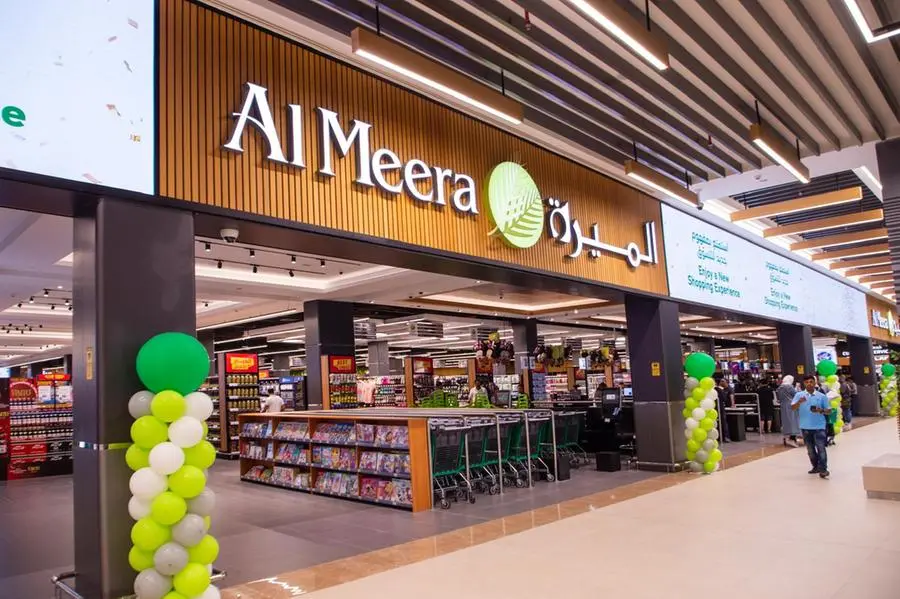
Al Meera is the most distinctly Qatari supermarket chain on this list and one of the most trusted by both local families and long-term expats. With dozens of branches spread across neighborhoods throughout the country, Al Meera is often the most conveniently located option for day-to-day shopping rather than a big monthly haul. It is particularly good for fresh bread, local produce, dairy products including Baladna items, and Arabic-label products that can be harder to find at the big international hypermarkets. Al Meera also runs regular promotional offers and loyalty programs.
A large number of Al Meera branches are now confirmed open 24 hours, listed in full below.
Website: almeera.com.qa
Monoprix
Monoprix is the premium French retailer in Qatar and the go-to for anyone looking for gourmet, organic, specialty imported, and European products that are simply not available anywhere else. If you are looking for a specific French cheese, a particular European brand of pasta, natural beauty products, or high-quality cookware, Monoprix is where you go. It is not the cheapest option and is not designed to be, but for the quality and the uniqueness of what is available, it is worth it.
Monoprix branches open 24 hours include Al Waab 2022, Medina Centrale at The Pearl Qatar, and Palm Tower West Bay Al Dafna. The Monop’ format at Le Boulevard Al Sadd and Tower 13 Porto Arabia The Pearl is a smaller convenience version of the Monoprix brand also open around the clock.
Website: monoprix.qa
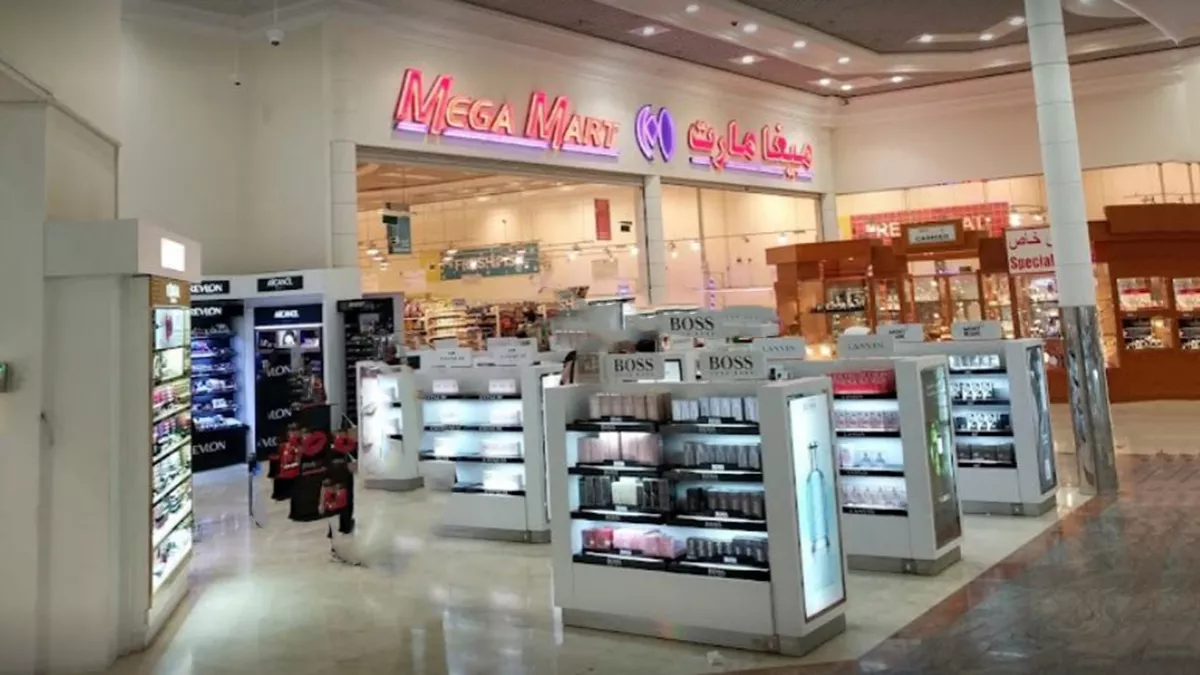
Mega Mart
Mega Mart specialises in high-quality international brands and fresh foods, making it a popular choice for expat families looking for specific products from home that the bigger hypermarkets do not always carry. It is particularly well regarded among communities looking for specific British, American, or specialty international products.
Rawabi Hypermarket
Rawabi is a popular mid-sized hypermarket that serves as a good alternative to LuLu and Carrefour for regular grocery shopping. It has a loyal customer base and is particularly convenient for residents in the Al Rayyan area.
Souq Al Baladi is one of the better-known local Qatari grocery chains, with locations in Abu Hamour and Al Markhiya. It is a solid mid-range option for everyday grocery shopping with a good range of local and regional products.
Locations: Zone 58, Street 819, Abu Hamour (+974 5090 2222), Al Markhiya Qatar Complex (+974 4411 3999) Website: albaladi-qatar.com Instagram: @souqalbaladiqatar
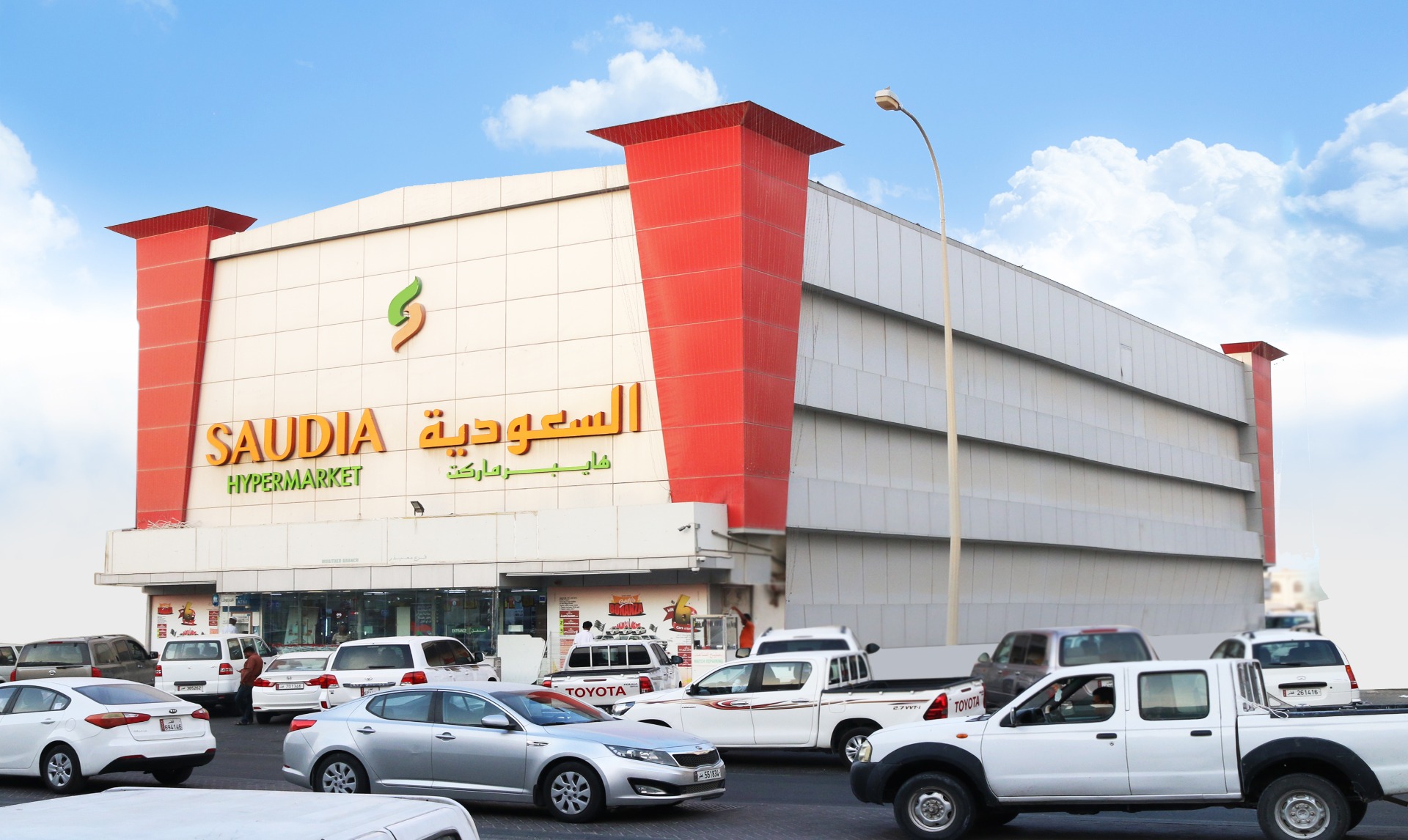
Saudia Hypermarket
Saudia Hypermarket is a popular option in the Al Rayyan area with two branches and a strong following among residents in that part of the city.
Locations: Alahbabi 2, 740 Al Muaither St, Ar-Rayyan (+974 4418 1786) and 7CQC+743, Al Shafi, Ar-Rayyan (+974 4480 8786) Website: saudiagroup.com
What Is the Cheapest Supermarket in Qatar?
If budget is the main consideration, LuLu Hypermarket consistently comes out as the most affordable option for everyday groceries in Qatar, particularly for fresh fruit and vegetables, rice, cooking oil, dairy, and South Asian staples. Al Meera is also very competitive on pricing especially for local and Qatari-produced items.
For specific product categories, Carrefour’s own-brand range offers good value, and independent supermarkets like Dohar Hypermarket, Saudia Hypermarket and Remash Supermarket can sometimes undercut the big chains on specific items.
If you are shopping for a large family on a fixed budget, combining a monthly LuLu visit for bulk items with regular top-ups at your nearest Al Meera branch is the approach most long-term residents settle on.
Which Supermarket Is Best for International and Specialty Products?
For imported and specialty international products, the ranking is fairly clear. Monoprix leads for European, French, organic and gourmet products. Mega Mart is strong for international brand-name products not available elsewhere. LuLu carries the widest range of South Asian, Southeast Asian and Middle Eastern products. Carrefour has a solid European and international section alongside its standard range. New Indian Supermarket and Retail Mart is an excellent specialist option for South Asian groceries and products.
Supermarkets in Qatar Open 24 Hours
One of the genuinely practical advantages of living in Qatar is that grocery shopping at 2 AM is a completely normal and well-supported activity. The following branches have been officially confirmed as operating 24 hours.
LuLu Hypermarket branches open 24 hours: D-Ring Road, Al Gharafa, Al Messila, Al Khor Mall, Barwa City, Pearl Island, Abu Sidra Mall, Ain Khaled, Al Wukair, Al Meshaf, Salwa Road, and Al Hilal.
Carrefour branches open 24 hours: City Center Mall, Al Mirqab Mall, and Lagoona Mall.
Monoprix branches open 24 hours: Al Waab 2022, Medina Centrale The Pearl Qatar, and Palm Tower West Bay Al Dafna.
Al Meera branches open 24 hours: Al Wakrah Old Wakrah, Al Sailiya South, Ain Khaled, Al Mansoura, Al Wajbah, Rawdat Egdaim, Izghawa Old, Hazm Al Markhiya, Al Khor, Rawdat Al Hamama, Al Thumama, Bu Sidra, Legtaifiya West Bay Lagoon, Jeryan Jenaihat, and Muraikh.
Kenz Baladna Old Airport is also confirmed open 24 hours.
The Ministry of Commerce and Industry has confirmed the availability of goods and products in large quantities across these retail outlets, ensuring market stability and the normal flow of supplies.
Independent 24-Hour Supermarkets Across Doha
Beyond the major chains, Doha has a network of independent and neighborhood supermarkets that operate around the clock. These are particularly useful for late-night top-ups, proximity to specific residential areas, and product ranges that sometimes differ from the big hypermarkets.
Al Meera Hypermarket and Supermarket Al Mansoura: +974 4042 7000 Al Qutaifiya Legtaifiya: +974 4483 7995 Website: almeera.com.qa
Doha Bazaar Supermarket Location: 7GPR+636, Jabr Bin Mohammed St Contact: +974 5083 3899 Facebook: @DOHA-BAZAR-Supermarket
Dohar Hypermarket Location: 7CF7+7VW, Al Muaither St, Ar-Rayyan Contact: +974 4468 3322 or +974 5066 5654 Facebook: @Doharhyper
Foodcare Supermarket Location: Gharrafat Al Rayyan Contact: +974 4487 0572
Monop’ (Convenience format) Le Boulevard, Al Sadd: +974 3355 0628 Tower 13, Porto Arabia, The Pearl: +974 4477 5171 Website: monoprix.qa
Souq Al Baladi Zone 58, Street 819, Abu Hamour: +974 5090 2222 Al Markhiya Qatar Complex: +974 4411 3999 Website: albaladi-qatar.com Instagram: @souqalbaladiqatar
Star Food Supermarket Location: Street 965, Al Sandal St Contact: +974 4464 2915
Star One Supermarket Location: 7GGM+QQ6, Salaja St, Al Doha Al Jadeeda Contact: +974 3002 7793 Facebook: @STAR-ONE-Supermarket
Online Grocery Delivery in Qatar
Most major supermarkets in Qatar now offer online grocery delivery, which has become one of the most popular ways to shop for essentials without leaving home. LuLu Hypermarket and Carrefour both have dedicated apps and websites for delivery. Al Meera offers online shopping through its website and selected delivery partners. Monoprix is available through its website and via Talabat.
Third-party delivery platforms including Talabat, Snoonu and Rafeeq also carry grocery stores and hypermarkets, giving access to same-hour delivery on many everyday items. For a 24-hour city like Doha, this means groceries are genuinely available at any time of day or night through one channel or another.
Frequently Asked Questions
What is the best supermarket in Qatar? LuLu Hypermarket is the most popular choice overall due to its scale, competitive pricing and variety. For premium and specialty products, Monoprix is the best option. For convenience and neighborhood access, Al Meera is the most widespread chain.
What is the cheapest supermarket in Qatar? LuLu Hypermarket is generally considered the most affordable option for everyday grocery shopping in Qatar, particularly for fresh produce, bulk items and South Asian products. Al Meera is also very competitive on pricing.
Which supermarkets in Qatar are open 24 hours? LuLu Hypermarket has 12 branches confirmed open 24 hours including D-Ring Road and Al Gharafa. Carrefour has three 24-hour branches at City Center Mall, Al Mirqab Mall and Lagoona Mall. Al Meera has 15 confirmed 24-hour branches. Monoprix has three 24-hour branches. Kenz Baladna Old Airport is also open 24 hours.
Is there online grocery delivery in Qatar? Yes. LuLu, Carrefour, Al Meera and Monoprix all offer online delivery. Talabat, Snoonu and Rafeeq also carry grocery partners for same-hour delivery across Doha.
Where can I buy international grocery brands in Qatar? Monoprix is the best for European and gourmet imports. Mega Mart is strong for international brand names. LuLu carries the widest range of South Asian and Middle Eastern products. Carrefour has solid European and international selections.
Does LuLu Hypermarket have branches across Qatar? Yes. LuLu has multiple branches across Doha and Qatar including D-Ring Road, Al Gharafa, Al Messila, Al Khor Mall, Barwa City, Pearl Island, Abu Sidra Mall, Ain Khaled, Al Wukair, Al Meshaf, Salwa Road and Al Hilal, all confirmed open 24 hours.
25 Arrested After Viral Video of Restaurant Fight in Dafna, Doha: MOI Qatar Statement
A video showing a mass altercation at a restaurant in the Dafna area of Doha went viral on social media, and Qatar’s Ministry of Interior has responded swiftly. Twenty-five individuals of Arab nationality have been arrested in connection with the incident, and all have been referred to the Public Prosecution for further legal action.
The Qatar Ministry of Interior issued an official press release confirming the arrests after footage of the Dafna restaurant fight circulated widely across social media platforms. The Ministry confirmed that competent authorities immediately initiated the necessary legal procedures upon becoming aware of the incident.
What Happened at the Dafna Restaurant
According to the official MOI Qatar statement, the incident involved an altercation between a number of individuals at a restaurant in the Dafna area of Doha. The conduct shown in the video constituted an assault on the safety of individuals and property, and was considered a breach of public security and public order under Qatari law.
The video spread rapidly across social media platforms, drawing widespread attention both within Qatar and internationally. The Ministry of Interior confirmed it was aware of the circulation of the footage and moved immediately to address the incident through official legal channels.
25 Arrested, Referred to Public Prosecution
Qatar’s Ministry of Interior confirmed that 25 individuals of Arab nationality were arrested following the Dafna restaurant incident. The required legal procedures have been completed in preparation for their referral to the Public Prosecution for further legal action.
The Ministry did not specify the nationalities of those arrested beyond confirming they were of Arab nationality, and did not identify the specific restaurant or its location within the Dafna area beyond the district name.
MOI Qatar: Zero Tolerance for Public Order Violations
In its official press release, the Ministry of Interior issued a direct warning to the public. The Ministry urged all members of the public to comply with laws and regulations, act responsibly, and refrain from any behavior that may disturb public order or compromise security and safety.
The Ministry further emphasized that it will not tolerate any acts that violate the law, and will take strict legal action against anyone found to have engaged in conduct that threatens the safety and security of society. This statement is consistent with Qatar’s established approach to public order violations, particularly in a period when the country is hosting significant international visitors and events during the FIFA World Cup 2026.
Qatar During the World Cup: Public Order in Focus
The Dafna restaurant incident comes during the FIFA World Cup 2026 period, when Qatar is experiencing a significant increase in international visitors and public attention. Authorities across the country have maintained a visible presence throughout this period, and the swift response to the Dafna altercation, from viral video to 25 arrests and Public Prosecution referral, reflects the government’s commitment to maintaining public security.
For anyone in Qatar during the World Cup period, understanding public order laws is important. Behavior that constitutes a breach of public security or an assault on individuals or property is treated seriously under Qatari law regardless of nationality, and as this case demonstrates, authorities act quickly when incidents come to public attention.
What happened at the Dafna restaurant in Doha? A video showing a mass altercation at a restaurant in the Dafna area of Doha went viral on social media. The incident involved unlawful conduct that was deemed an assault on the safety of individuals and property, and a breach of public security and order.
How many people were arrested in the Dafna restaurant fight? 25 individuals of Arab nationality were arrested by Qatar’s Ministry of Interior following the incident.
What will happen to those arrested in the Dafna incident? All 25 arrested individuals have been referred to the Public Prosecution for further legal action, according to the official MOI Qatar statement.
Where is Dafna in Doha? Dafna is a district in central Doha, located in the West Bay area. It is one of Doha’s key commercial and residential zones.
What did MOI Qatar say about the Dafna restaurant incident? Qatar’s Ministry of Interior issued an official press release confirming the 25 arrests, urging the public to comply with laws and regulations, and emphasizing zero tolerance for conduct that threatens public safety and security.
Is it safe to go to restaurants in Doha? Yes. Qatar maintains strict public security standards and authorities respond rapidly to incidents. The swift arrest of 25 individuals following this incident reflects the effectiveness of Qatar’s law enforcement response.
Source: Qatar Ministry of Interior official press release, @moi_qatar and @moi_qataren on X.
Escape the heat and get ready for the ultimate shopping experience! Doha Festival City, Doha’s destination for style expression, and coveted trends, is launching its first-ever mid-year Super Sale Festival 2026 from 24 June to 4 July, with extended opening hours until 11:00 PM on weekdays and 12:00 AM (midnight) on weekends!
With big savings reaching up to 75%, exclusive offers across your favorite global and local brands, dining offers, and extended late-night hours, it is the perfect excuse for some indoor retail experiences with family and friends.
Here are 6 ultimate reasons why you need to mark your calendar and head over to Doha Festival City!
1. Upgrade Your Summer Wardrobe with Elite Fashion Deals
Discover gorgeous seasonal looks, chic daily ensembles, and timeless apparel with discounts ranging between 20% to 60% across leading retail names such as Abercrombie & Fitch, Riva, Sfera, Massimo Dutti, Mango, Tommy Hilfiger, and Calvin Klein.
2. Take Your Fitness and Activewear Game to the Next Level
Score premium activewear, performance-ready sneakers, and workout accessories with savings ranging between 20% to 50% from top global and local brands such as lululemon, New Balance, Nike, Adidas, Decathlon, Sketchers, Go Sport, and Asics.
3. Refresh Your Beauty Cabinet with Top-Tier Skincare & Makeup
Enjoy radiant finishes, hydrating skincare formulas, and bold makeup collections with discounts ranging between 25% to 70% (with beauty and body care favorites reaching up to 75%) at major beauty hotspots such as KIKO Milano, Wycon Cosmetics, Bath & Body Works, Gold Apple, Rituals, and Inglot. Plus, enjoy exclusive gifts-with-purchase and special customized sets at Asteri and Benefit.
4. Sparkle Under the Sun with Exquisite Jewellery & Accessories
If you’re looking for a timeless piece or add luxury to your everyday style, look no further than the offers from fine jewellery and accessory brands with incredible mid-year deals. Exceptional savings ranging between 25% to 50% at prestigious boutiques such as Djula, Johara, Farah, One Diamond Jewellery, Parfois, and Aldo Accessories.
5. Give Your Home a Makeover and Keep the Kids Happy
Redecorate your living space or update your children’s wardrobe and toy collections with discounts ranging between 15% to 75% from family favorites such as Zara Home, Tansy Mattress, Lego, Toys R Us, The Children’s Place, and Ziddy.
6. Roll the Dice for Free Treats & Enjoy Global Flavors
Enjoy group menu deals such as those at Asha’s or a discount of up to 15% off at Shanghai Garden Express and up to 50% at Sushi Library. Best of all, stop by Jamie’s Italian for an exciting, interactive “Roll the Dice” game to win a free treat for your next visit!