

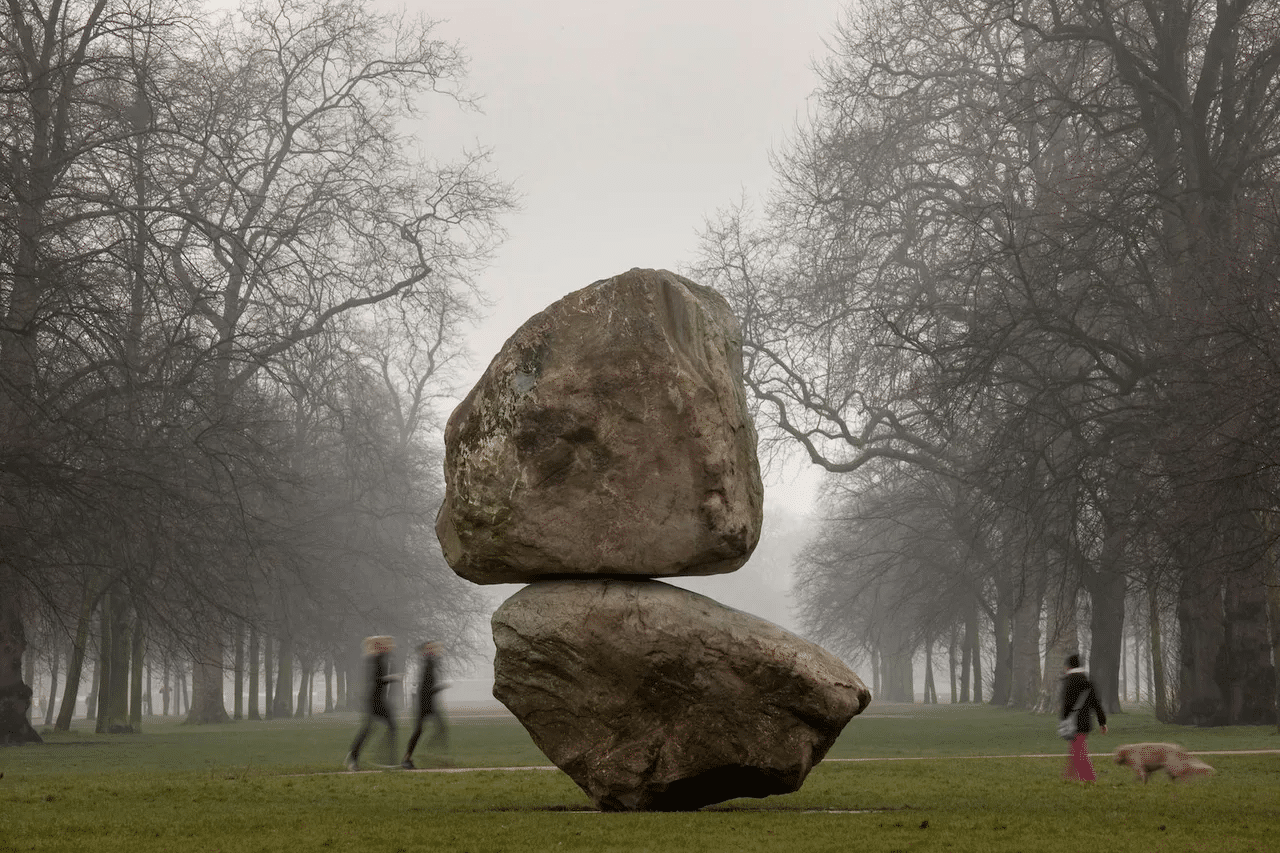
Set against the open landscape of MIA Park, Rock on Top of Another Rock stands as a quiet yet powerful meditation on balance, time, and cultural exchange. The monumental public sculpture by Peter Fischli and David Weiss has found its permanent home in Doha, continuing a journey that began more than a decade ago.
Positioned beside the entrance of QM Gallery Al Riwaq, the work features two massive granite boulders stacked in a seemingly precarious balance. Rising 5.5 metres high, the sculpture plays with opposing forces: stability and instability, weight and suspension, construction and collapse. What appears impossible becomes quietly convincing, inviting visitors to pause and reflect.
A Sculpture That Travels With Meaning
First presented in London in 2013 as part of the Qatar UK 2013 Year of Culture, Rock on Top of Another Rock was always intended to move. Its relocation to Doha fulfils that original vision, reinforcing the idea that cultural dialogue does not end with a single exhibition or year.
Instead, it evolves through shared spaces and lived experiences. In Doha, the sculpture takes on new resonance, framed by the city’s skyline, sea views, and daily rhythms of MIA Park.
Art as Ongoing Cultural Exchange
The presence of Rock on Top of Another Rock in Qatar reflects how artistic exchanges can bridge geographies and sustain conversations across borders. What began as a moment within a bilateral cultural programme now lives on as part of Doha’s public realm, accessible to all.
Here, the work encourages reflection rather than explanation. It asks viewers to consider balance not as a fixed state, but as something temporary, negotiated, and deeply human.
Visiting Rock on Top of Another Rock
- Location: MIA Park
- Near: Entrance of QM Gallery Al Riwaq
- Artist: Peter Fischli & David Weiss
- Height: 5.5 metres
- Material: Granite
In a city defined by rapid growth and transformation, Rock on Top of Another Rock stands as a reminder that meaning often lies in equilibrium, in the tension between forces, and in the quiet power of shared cultural moments.
Source – Years of Culture