

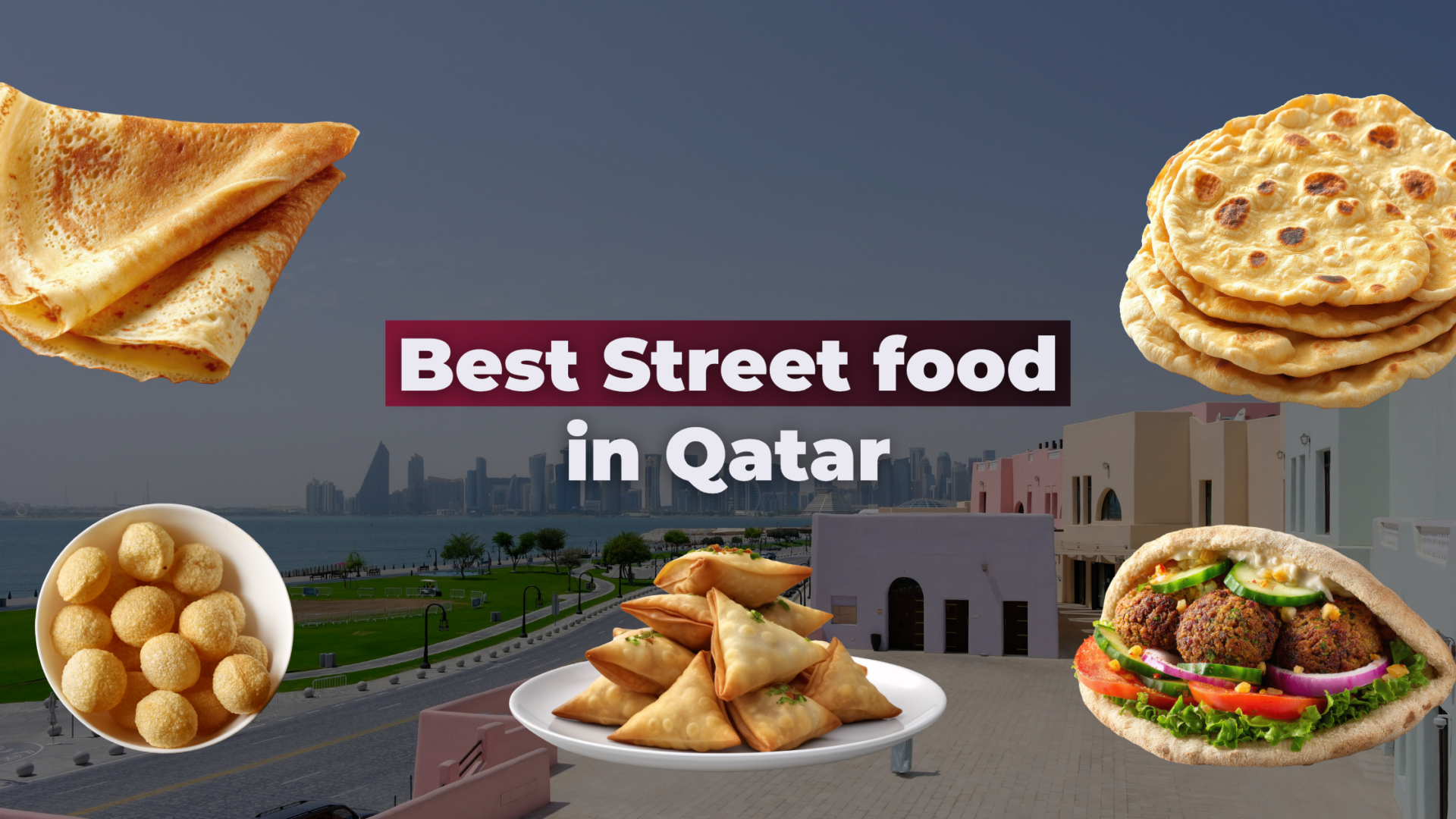
Best Street Food in Qatar 2026: Traditional Dishes, Where to Eat and What to Order
Food is one of the best ways to understand any city, and in Doha that is truer than almost anywhere else. Qatar sits at a cultural crossroads where Arab, South Asian, Levantine and Persian food traditions have been layering on top of each other for generations, and what comes out of that mix is some of the most interesting, flavourful and underrated street food in the Middle East.
This is not the Qatar of fine dining and Michelin stars, though that exists too. This is the Qatar of steaming karak at midnight, of shawarma sliced straight off the spit at a counter you walk up to without a reservation, of luqaimat fresh out of the fryer from a woman at Souq Waqif, of samboosas so hot you have to blow on them before you bite. This is the real Qatar, and it tastes incredible.
Whether you are visiting for the World Cup, arriving as a new expat trying to figure out what to eat, or a long-term resident who wants a proper guide to all the traditional food of Qatar worth knowing about, this is the article. Every must-try dish with honest descriptions, specific places to go with names and locations, what to expect to pay, and how to work your way through Doha’s street food scene like someone who actually knows what they are doing.
For more ways to explore Doha this summer, check our Doha Summer Survival Guide 2026 and our best affordable restaurants in Doha guide for sit-down options that will not break the budget.
Karak Tea: The Non-Negotiable Starting Point

Before anything else, before the food, before the shawarma, before any exploration of Qatar’s culinary landscape, you need a cup of karak. It is not optional. Karak is the social lubricant of this city, the reason every street corner has a tea shop, and quite possibly the most important beverage in Qatar’s daily life.
Karak is black tea brewed with milk, sugar, cardamom, and sometimes saffron and ginger, simmered until it is thick, sweet, and deeply aromatic. The result is a drink that is completely different from any cup of tea you have had before. It is rich without being heavy, sweet without being cloying, and warming in a way that somehow works even in summer.
It costs somewhere between QAR 1 and QAR 3 at most street-facing tea shops depending on the size and location, which makes it one of the best-value drinks in the city. You order it, you take it in a small plastic cup, you stand at the counter or sit on a plastic chair outside, and you understand immediately why people in Doha drink three or four of these a day.
Where to get the best karak in Doha:
Chapati and Karak at Katara Cultural Village is the most famous dedicated karak spot in the city. Shay Al Shamoos at Souq Waqif is another institution with a devoted following. For a specialty tandoori karak, the Karak Stop at Mall of Qatar is worth the trip. Karaki at The Pearl and Chai Halib at Mall of Qatar are popular options for a slightly more polished setting.
Chapati and Poori: Karak’s Perfect Partner
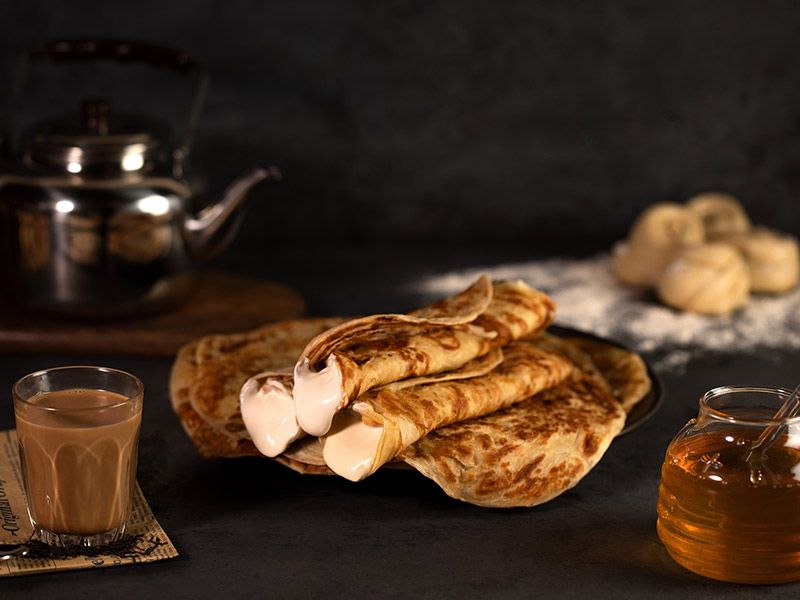
Once you have your karak, you need something to eat with it, and in Qatar the answer is almost always chapati or poori. These are flatbreads that trace their roots back to the Indian subcontinent but have become completely embedded in Qatar’s food culture, served at every tea shop and karak counter across the city.
Chapati is thin and slightly chewy with a lightly charred surface. Poori puffs up when it hits the oil, giving it a crispy, airy texture that is genuinely addictive. Both can be eaten plain or rolled around fillings ranging from savoury options like spiced mince and cheese to sweet combinations like honey and Nutella. Eaten fresh off the griddle with a cup of karak in hand, this is one of the best cheap meals in Qatar, often costing just a few riyals.
Where to eat:
Chapati and Karak at Katara is the obvious first stop. Shay Al Shamoos at Souq Waqif does excellent versions as well. Most local karak shops and Indian-run tea houses across Doha serve some variation of this pairing.
Shawarma: The King of Qatar’s Street Food Scene
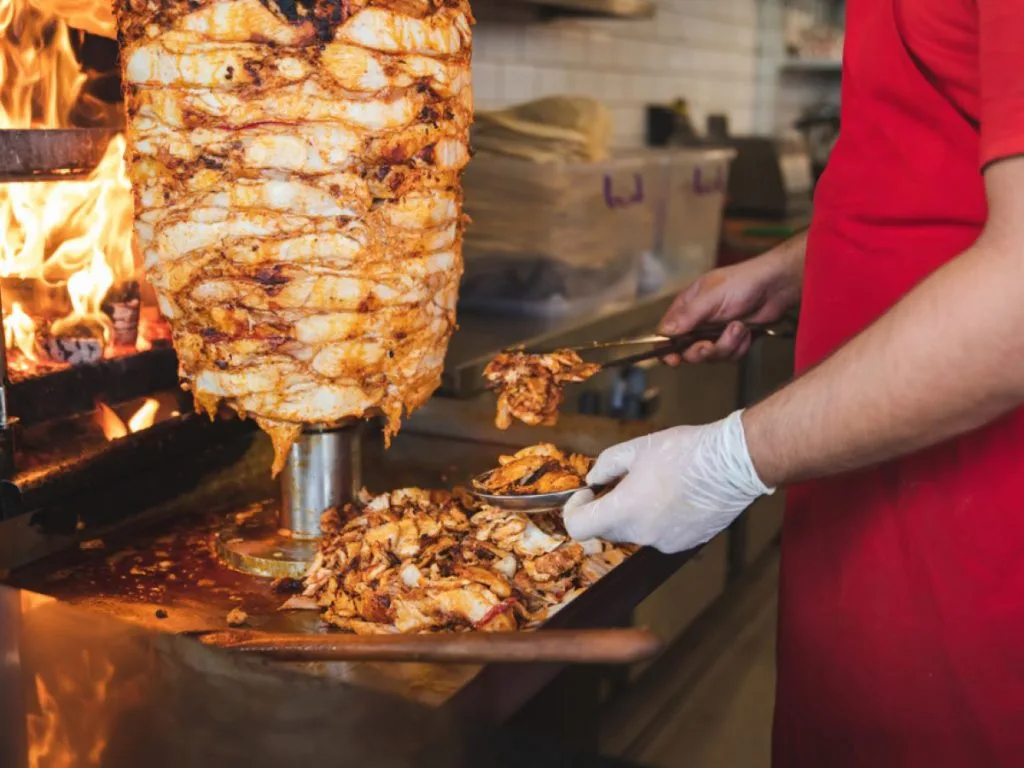
If there is one dish that represents street food across the entire Middle East, it is shawarma, and Qatar does it exceptionally well. The basic concept is simple: boneless strips of chicken or beef are layered and marinated, then stacked and slow-roasted on a vertical rotating spit. As the meat cooks, the outer layer crisps up and gets sliced thin, then wrapped in bread with garlic sauce, pickles, tomatoes and sometimes fries tucked inside.
The execution, though, varies enormously. Lebanese shawarma comes in thin pita with a heavy hand of toum garlic sauce. Syrian versions lean toward thicker wraps with more vegetables. The Turkish style uses slightly different spicing. The generic “Arabic” version, which is what you find most commonly in Qatar, is usually wrapped in soft khubz bread and is deeply satisfying in a way that is hard to articulate without just eating one.
A good shawarma in Doha costs between QAR 5 and QAR 15 depending on where you go and what goes in it. It is a perfect late-night option because shawarma shops stay open very late, sometimes through the night.
Where to eat the best shawarma in Doha:
Mashawi Al Arabi in the Old Airport area is one of the most recommended spots among long-term residents for an authentic and properly made shawarma. Jabal Lebnan on Al Nasr Street is another institution with consistent quality. Al Bisana in Katara is a reliable option if you are already in that part of the city. Petra has multiple locations across Doha and is a go-to for many residents.
Falafel: The Best Vegan Street Food in Qatar

Falafel is one of those foods that sounds simple but is absolutely devastating when made well and genuinely disappointing when done badly. The good news is that in Doha, it is almost always made well.
The Qatar and Levantine style of falafel uses ground chickpeas, fava beans, or a combination of both, mixed with garlic, parsley, coriander and spices, then shaped into small balls or flat discs and deep-fried until the outside is crackly and golden and the inside is soft and vivid green. Eat it plain, stuff it into pita with tahini sauce, pickles and fresh salad, or order a falafel platter as part of a larger spread.
It is a brilliant breakfast option, a perfect quick snack, and completely plant-based, making it one of the most accessible dishes in Qatar for every type of eater. Price-wise, falafel in Doha is among the most affordable bites you can find, usually between QAR 3 and QAR 10 depending on portion size.
Where to eat the best falafel in Doha:
Falafel AlAkawi is one of the dedicated falafel chains in Qatar worth knowing about. Zater wa Zeit has locations around Doha and does excellent versions. Layali Al Qahira while wandering around the souq area is a good local option. For something slightly more elevated, Khan Farouk and Ard Canaan in Katara both serve stuffed and baked falafel variations that are worth the extra few riyals.
Samboosa: The Snack That Goes With Everything
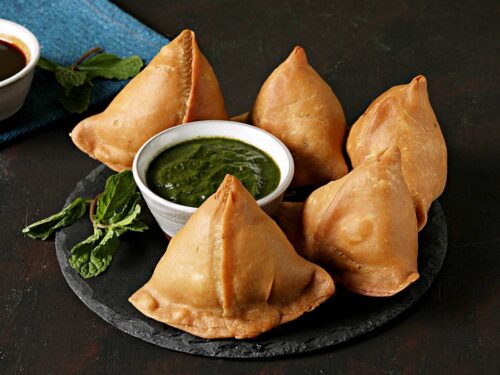
Samboosa is Qatar’s version of the universal fried dumpling that exists in some form across almost every food culture in the world. Here it takes the form of small triangular pastries with thin, crispy shells stuffed with spiced minced meat, spinach, cheese, or a combination of all three. They are deep-fried until the pastry is shatteringly crisp, then served hot with chutney or yoghurt dipping sauce on the side.
They are enormously popular during Ramadan, when breaking the fast with a samboosa and karak is a near-universal tradition, but they are available year-round across Doha at bakeries, tea shops and restaurant starters menus. A small bag of samboosas costs almost nothing, which is part of why they are so beloved.
Where to eat the best samboosa in Doha:
Delhi Bakery in Doha Jadeeda is one of the most reliable spots for consistently good samboosas throughout the day. Soghaat on Salwa Road is another popular option. For a slightly more refined version, the chicken samosas at the Spice Market at W Doha Hotel are worth the step up in price.
Ragag: The Traditional Qatar Crepe You Have Never Heard Of

Ragag is the one on this list that most visitors miss entirely, which is a genuine shame because it is one of the most interesting and distinctly Qatari street foods you can find. Paper-thin and crispy, folded into a cone or rolled flat, ragag has a wafer-like texture that is completely different from either a Western crepe or a South Asian roti. It is eaten hot, either plain with tea, wrapped around kebabs, or topped with fillings like cheese, eggs, honey, or mhyawa, a traditional thick fish paste that is spread directly onto the bread as it cooks.
The experience of eating ragag, particularly at Souq Waqif where local women set up stalls and cook it fresh in front of you, is one of those moments in Doha that stays with you. It is genuine, it is traditional, it is cheap, and it is very, very good.
Where to eat ragag:
The central square at Souq Waqif is the most authentic place to try ragag in Qatar, where local women cook and sell it fresh at their stalls. Shay Al Shamoos at Souq Waqif also serves what many consider the best rigag in the city.
Luqaimat: The Sweet Street Food You Cannot Eat Just One Of
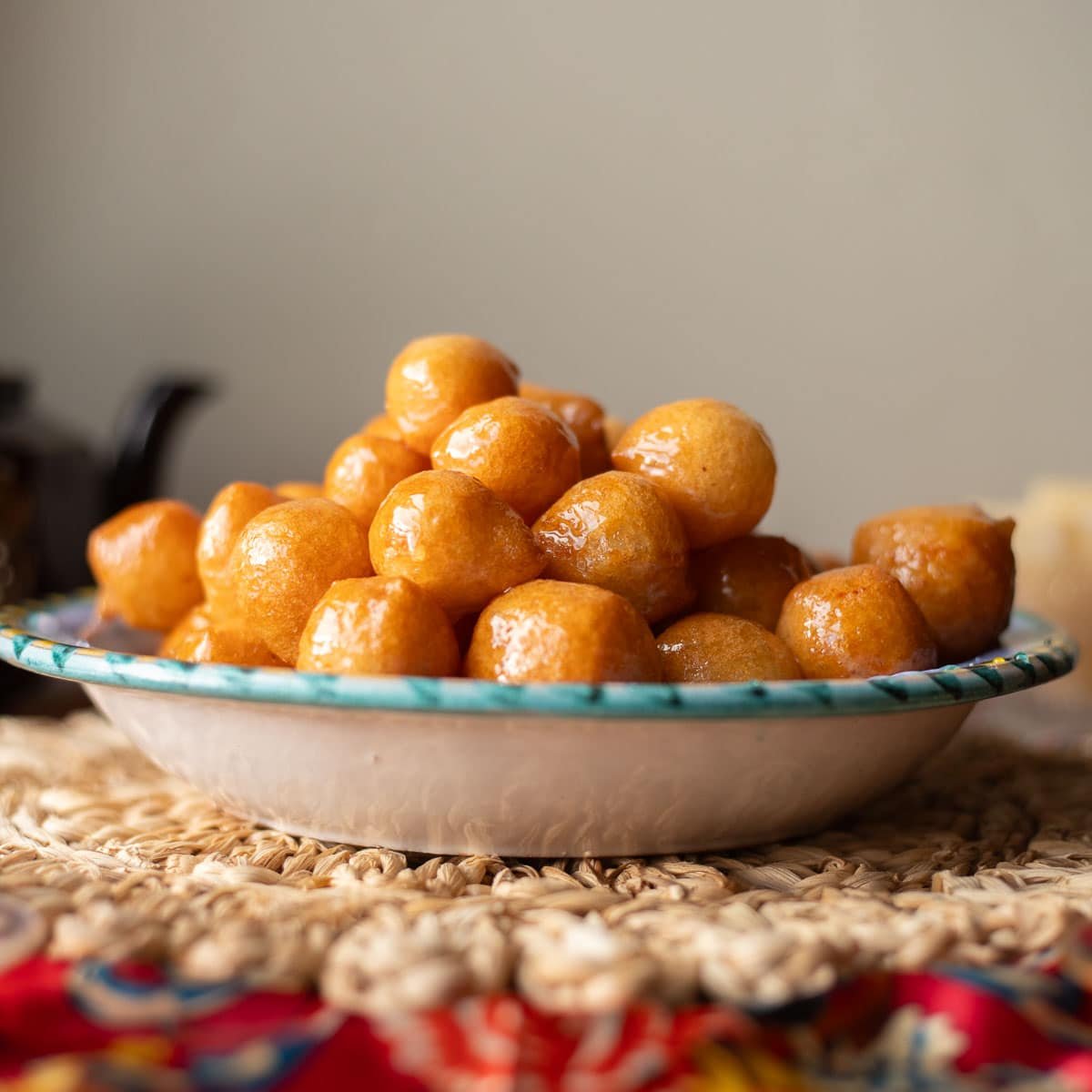
Luqaimat are sweet flour dumplings, round and about the size of a large marble, that come out of the fryer with a golden, slightly crispy shell and a warm, soft, almost gooey centre. They get soaked in date syrup or sugar syrup and are flavoured with cardamom and saffron, which gives them a warmth and fragrance that makes them completely impossible to stop eating.
They are a Ramadan staple, sold everywhere during iftar, but they are available year-round at karak shops and traditional sweet stalls. The absolute non-negotiable rule with luqaimat is that they must be eaten immediately while they are still hot and fresh. A cold luqaimat is a sad luqaimat.
Price-wise, a serving of luqaimat in Doha is genuinely affordable, usually between QAR 5 and QAR 15 depending on size and location.
Where to eat luqaimat:
Local women selling homecooked foods at Souq Waqif are the most authentic source and the most fun experience. Karaki at The Pearl and Chai Halib at Mall of Qatar both serve good luqaimat in a slightly more accessible setting.
Harees: Qatar’s Most Comforting Traditional Food
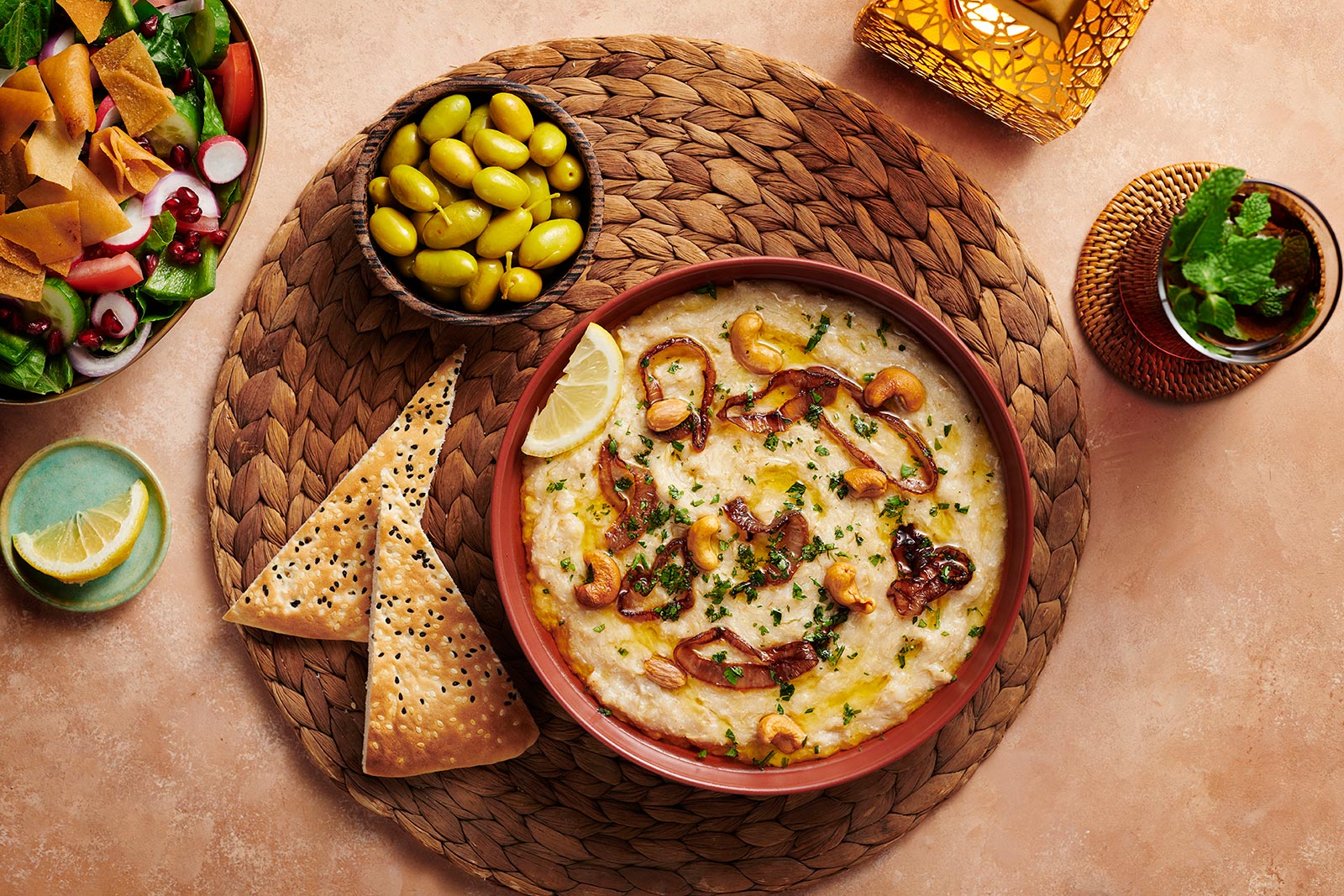
Harees is the dish that most visitors to Qatar never try and most long-term expats discover during Ramadan and then cannot stop thinking about. It is slow-cooked wheat and meat, usually chicken or lamb, simmered together for hours until they become a thick, porridge-like consistency seasoned with salt, pepper, and sometimes a drizzle of ghee on top.
It sounds simple and it is, which is exactly why it works. Harees is deeply satisfying comfort food in the truest sense, the kind of dish that feels like it has been feeding people for centuries, which it essentially has. It is a staple of Qatari traditional cuisine and one of the most important dishes in the local food culture.
Where to eat harees:
Souq Waqif has several spots that serve harees, particularly during Ramadan. Select traditional Qatari restaurants in Doha serve it year-round.
Knafeh: The Street Dessert Worth Going Out of Your Way For
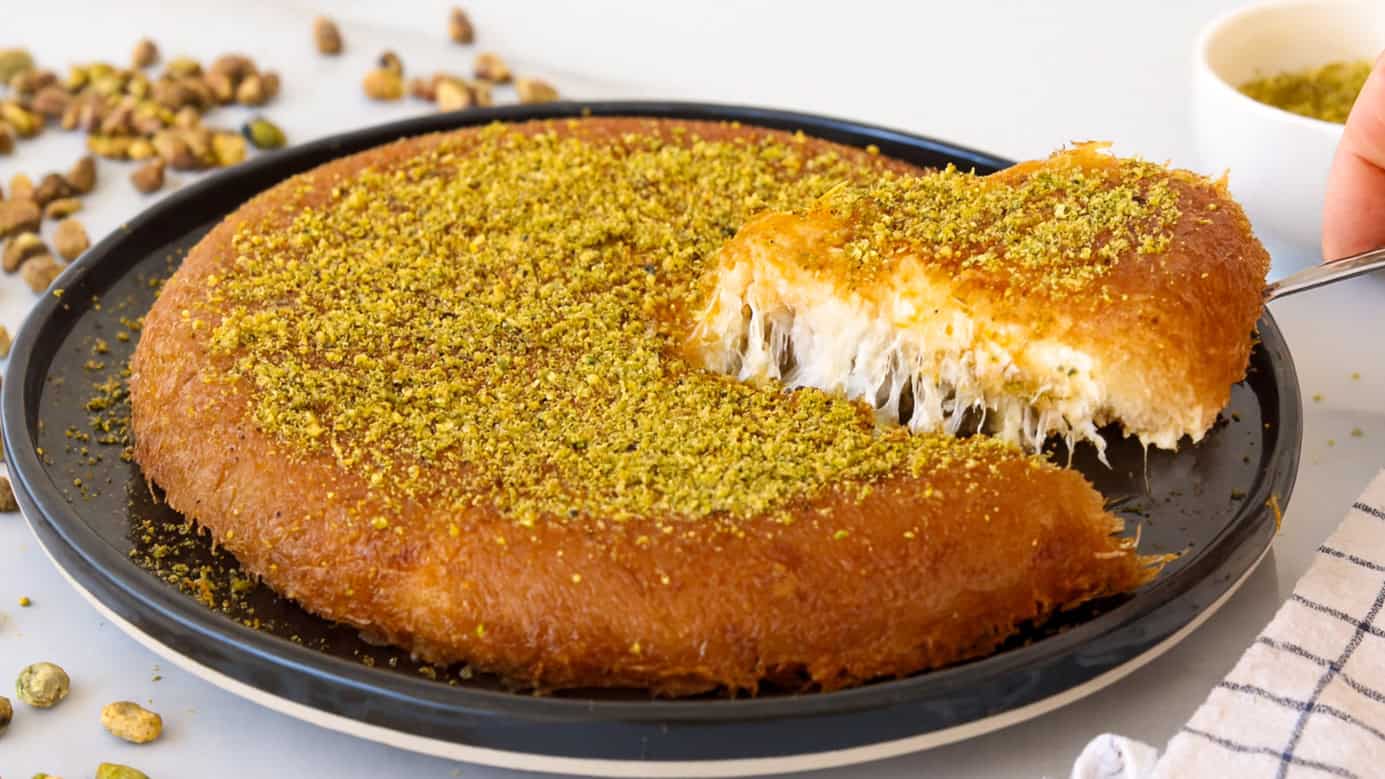
Knafeh is the dessert version of the street food experience in Qatar and it deserves its own mention. Layers of shredded pastry or fine semolina are packed around a filling of soft white cheese, baked until golden and crispy, then soaked in fragrant sugar syrup and finished with crushed pistachios on top. It is sweet, it is rich, it is slightly salty from the cheese, and it is best eaten warm directly from the tray.
Where to eat knafeh:
Multiple sweet shops around Doha serve knafeh, particularly in areas with strong Levantine community presence. Souq Waqif has several options worth exploring.
Pani Puri: The Indian Street Snack that Doha Loves

Qatar’s large South Asian community has brought pani puri firmly into the mainstream Doha street food consciousness. These are small, hollow, crispy spheres that you fill with a mixture of spiced potato, chickpeas and tamarind chutney, then flood with tangy, spiced water and pop into your mouth whole. The combination of textures and the explosion of flavour is genuinely like nothing else you can eat.
Where to eat:
Old Mumbai Ice Cream at Family Food Centre on Old Airport Road is one of the spots most associated with South Asian street snacks in Doha. Indian and Asian grocery areas, particularly around the Old Airport Road area, have several stalls and small restaurants serving authentic pani puri.
Where to Find the Best Street Food in Doha
Souq Waqif
Souq Waqif is the single best place in Qatar to eat street food, full stop. The winding alleyways lined with spice shops, traditional restaurants and food stalls, the smell of grilling meat mixing with incense and freshly baked bread, the energy of the place in the evenings particularly, all of it makes Souq Waqif the most important food destination in the city for anyone who wants to understand what Qatar actually tastes like. Ragag stalls, karak shops, shawarma counters, knafeh trays, falafel spots and luqaimat vendors are all concentrated here. Go hungry, go in the evening, and plan to wander rather than stick to a list.
Old Airport Road Area
The Old Airport Road and its surrounding streets in Doha Jadeeda is where you find some of the most authentic and affordable Indian, Pakistani and Levantine food in the country. This is where long-term expats from South Asia and the Middle East shop and eat, which means the food is made the way it is actually supposed to be made rather than adjusted for a tourist audience. Shawarma spots, samboosa bakeries, karak shops and South Asian snack stalls all cluster here.
Al Wakrah Market
If you want a local market experience that is significantly less touristy than Souq Waqif, Al Wakrah market is the place. It has a genuinely local atmosphere and a good range of traditional food options, fresh fish from the nearby coast, and a relaxed pace that makes it perfect for an afternoon exploration.
Doha Corniche
The Corniche is less about the food stalls and more about the experience of eating while looking at one of the most beautiful waterfronts in the region. There are food trucks and informal vendors particularly in the evenings, and the combination of the Doha skyline view across the water with a cup of karak and some street snacks is hard to beat.
Box Parks and Container Cafes
Qatar’s local interpretation of street food culture often takes the form of refurbished shipping container parks, which house karak shops, specialty coffee spots, and quick-bite food stalls in a casual outdoor setting. These are spread across various parts of Doha and are particularly popular in the evenings among younger residents.
Frequently Asked Questions
What is the traditional food of Qatar?
Qatar’s traditional cuisine includes machboos (spiced rice with meat or fish), harees (slow-cooked wheat and meat), thareed (bread and meat stew), balaleet (sweet vermicelli with eggs), luqaimat (sweet fried dumplings), ragag (thin crispy crepes), samboosa, and dates with Arabic coffee which is served as a symbol of hospitality.
What is the best street food in Doha?
Shawarma, karak tea with chapati, falafel, samboosa, luqaimat and ragag are the most recommended street foods in Doha. Souq Waqif is the best single location to try all of them in one visit.
Where can I find affordable restaurants in Doha?
The Old Airport Road area has the most concentration of affordable and genuinely good restaurants in Doha. Souq Waqif also has options across a wide price range. For a full guide see our affordable Doha eating guide on People and Qatar.
How much does street food cost in Qatar?
Street food in Qatar is very affordable. Karak tea costs QAR 1 to QAR 3, chapati a few riyals, shawarma between QAR 5 and QAR 15, falafel from QAR 3 to QAR 10, samboosa from QAR 2 to QAR 5 per piece, and luqaimat between QAR 5 and QAR 15 per serving.
Is there vegetarian street food in Qatar?
Yes. Falafel, samboosa with cheese or vegetable filling, ragag with cheese or honey, luqaimat, pani puri, and knafeh are all vegetarian options widely available across Doha.
Where is the best place for street food in Qatar?
Souq Waqif is the most concentrated and atmospheric location for street food in Qatar. The Old Airport Road area is the best for affordable South Asian and Levantine street food. Al Wakrah Market offers a more local, less touristy experience.