
Education City Stadium Is Now the QNB Education City Stadium: Here Is Everything You Need to Know
One of Qatar’s most beloved stadiums just got a new name.
Qatar Foundation and QNB Group signed an official agreement on June 21, 2026 to rename Education City Stadium as the QNB Education City Stadium. The signing took place at the stadium itself, witnessed by HE Sheikha Hind bint Hamad Al-Thani, Vice Chairperson of Qatar Foundation, and Abdulla Mubarak Al Khalifa, CEO of QNB Group.
Under a five-year naming rights agreement, the venue that once hosted World Cup quarter-final football will now carry the name of Qatar’s largest bank and one of the most powerful financial institutions in the Middle East and Africa.
Here is the full story.
What Is the QNB Education City Stadium
The QNB Education City Stadium is what the world has long known as Education City Stadium, the extraordinary venue located at the heart of Qatar Foundation’s Education City campus in Al Rayyan, about 7 kilometres north-west of downtown Doha.
The stadium is one of eight venues built for the FIFA World Cup Qatar 2022, and it hosted eight matches during the tournament, including games up to the quarter-finals stage. If you are a fan of football in Doha, there is a very good chance you have been inside this stadium or passed by its unmistakable glittering exterior.
The name has now officially changed to QNB Education City Stadium, effective from the date of the signing on June 21, 2026.
Why Is It Called the Diamond in the Desert
Before we get into the details of the deal, it is worth understanding what makes this stadium so special. You do not earn a nickname like “Diamond in the Desert” without deserving it.
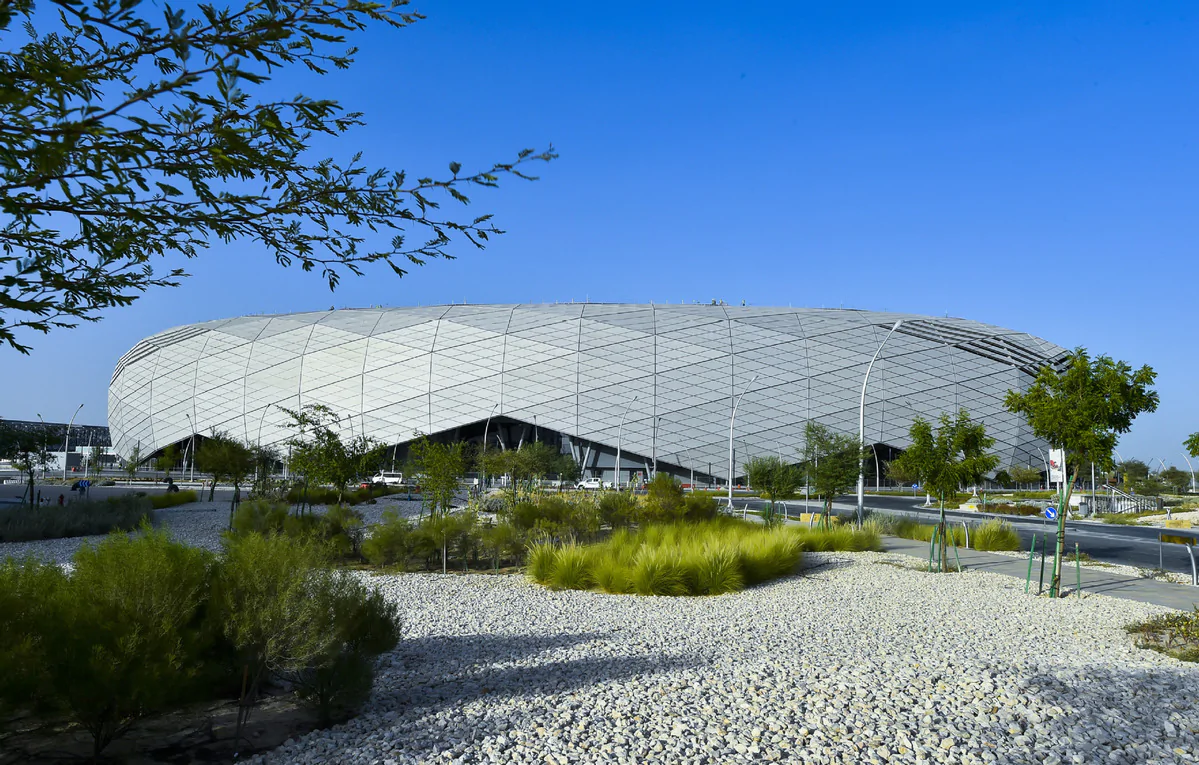
The stadium’s nickname refers to its facade, which is composed of a diamond-like pattern that takes its form from traditional Arabic architecture. The entire exterior is covered in tessellating triangular panels that change colour depending on where the sun is in the sky. During the day it shimmers. At night it becomes a full digital light show, illuminated by thousands of LEDs that turn the building into something that looks genuinely unreal from a distance.
The facade features triangles that form complex, diamond-like geometrical patterns, appearing to change colour with the sun’s movement across the sky. By night, the guise puts on a colourful light show, making it even more eye-catching.
The design was created by Spanish studio Fenwick Iribarren Architects in collaboration with London-based Pattern Design. The venue is located to the west of Doha in the Education City university district, which gives the building its name. Its facade is made from a tessellating triangular pattern that takes its form from Arabic architecture and is designed to deflect the country’s strong sunlight.
It is not just beautiful. It is also environmentally brilliant. The 40,000 capacity stadium dubbed “Diamond in the Desert” was designed by FIA Fenwick Iribarren Architects, situated 12km from the City Centre. It is the first Qatar 2022 stadium to receive a five-star GSAS sustainability rating.
That five-star Global Sustainability Assessment System rating made it the most environmentally certified World Cup stadium at the time of its completion. Its range of sustainability features include direct access to public transport, low toxicity indoor materials and LED sports lighting. In addition, 85% of building materials were regionally sourced, while 29% were generated from recycled materials.
The Full Details of the QNB Naming Rights Deal
The agreement was signed on June 21, 2026 at a ceremony held at the stadium. The deal runs for five years and sees QNB Group take on naming rights for the venue in a partnership that both organisations describe as a strategic alignment of values rather than a transactional sponsorship.
Signing on behalf of Qatar Foundation, Alanoud Al Mesnad, Executive Director of Women’s and Girls’ Sports at QF, said the agreement represents dedication by both institutions to women and girls in sport.
“This agreement is a symbol of the dedication of two Qatari institutions to supporting and increasing opportunities for women and girls to embrace, participate in, excel in, and benefit from sport in settings that are tailored specifically to their needs,” she said.
On the QNB side, the group’s Chief Risk Officer, Fatima Abdulla Al Suwaidi, framed the deal within Qatar’s national development agenda. “Our partnership with Qatar Foundation reflects a shared commitment to supporting education, youth development and national progress while contributing to the ambitions of Qatar National Vision 2030,” she said.
This is not a logo-on-a-banner deal. Both parties are linking the stadium, its programs and its community mission directly to their institutional values.
Who Is QNB Group
If you live in Qatar, you already know QNB. But for context, QNB Group is not just the biggest bank in Qatar. QNB Group is the biggest bank in Qatar. It is also the largest lender by assets in the GCC, according to S&P Global, with more than $323 billion in assets.
QNB was founded on 6 June 1964 as the country’s first domestically-owned commercial bank. As of March 2025, the QNB Group spanned over 28 countries across Asia, Africa, and Europe, and employed 31,000 people across 900 locations and 36 million current accounts.
It is 50 percent owned by the Qatar Investment Authority, the nation’s sovereign wealth fund. The other 50 percent is publicly traded. This is a bank that is deeply embedded in Qatar’s national story, which makes the partnership with Qatar Foundation particularly fitting. Two institutions that were both born from Qatar’s ambitions, now sharing a stadium name.
What Is Actually Happening at the QNB Education City Stadium
This is where it gets interesting. Because the QNB Education City Stadium is not just a name on a building that hosts a game every few weeks and then sits empty. The stadium has evolved into a genuinely active community hub since the World Cup.
It is currently home to several ongoing programs that make it one of the most purpose-driven sporting venues in the region.
Paris Saint-Germain Academy Qatar runs programs out of the stadium, giving young players in Doha access to one of the most recognised football academies in the world.
Ladies Sport Night is a Qatar Foundation initiative that runs regularly at the stadium, designed to give women and girls in Qatar the chance to try different sports, stay active and connect with a community of people who share those interests. It is free, it is open to all, and it has quietly become one of the most popular recurring events at the venue.
The stadium is also used for national and international sporting events, community engagement programs and school and university initiatives through the Qatar Foundation campus it sits within.
This is what the post-World Cup legacy actually looks like: a stadium that did not go quiet after December 2022, but instead found a new purpose serving the people who live nearby.
A Quick History of Education City Stadium
If you want to understand why this rename feels significant, you need to know a little history about the venue.
Construction began in 2016. The construction of the stadium was completed in June 2020, making it the third World Cup stadium to be completed. It officially opened on 15 June 2020.
The Stadium is located within the Qatar Foundation’s Education City and has a capacity of 40,000 spectators. Its location in the heart of Education City gives the Stadium its uniqueness as it is overlooking the most important main roads, starting from the Southern Khalifa district to the coastal city of Dukhan, and passing through many residential areas.
During the 2022 World Cup, the stadium hosted eight matches including six group stage games, a round of 16 and a quarter-final. After the tournament, the upper demountable tier was removed as planned, reducing capacity to around 25,000 seats. Importantly, the excess seating was donated to developing countries as part of Qatar’s World Cup legacy commitment.
The stadium is located within several university campuses at the Qatar Foundation’s Education City. Following the FIFA World Cup, the stadium will retain 25,000 seats for use by university athletic teams.
The stadium also has a genuinely unique piece of trivia attached to it. In February 2016, excavations uncovered rocks dating back 20 to 30 million years. Excavators dug 17 metres down, so the pitch can sit below sea level, where temperatures are cooler. That is not just engineering. That is the kind of detail that makes you stop and think about what went into building this place.
What This Means for Residents and Visitors in Doha
Practically speaking, if you are attending an event at what was previously called Education City Stadium, it is now the QNB Education City Stadium. The location has not changed. It sits within Education City in Al Rayyan, accessible by metro and car from central Doha.
If you are new to Qatar and looking for things to do in Doha, the QNB Education City Stadium is worth visiting even on non-match days. The surrounding Education City campus includes university buildings, green spaces, a golf course and public areas that make the whole zone a pleasant place to spend time.
For women and girls specifically, the Ladies Sport Night events at the stadium are one of the best free activities in Doha. Check Qatar Foundation’s social channels for upcoming dates.
If you are planning a visit to watch sport in Doha, keep this venue on your list. It regularly hosts Qatar Stars League matches, international events and community tournaments throughout the year.
For more on things to do in Doha this month, read our weekly Doha guide or check out the Doha Summer Survival Guide 2026.
Why Qatar Foundation and QNB Partnership Makes Sense
On paper, a bank and an education and science foundation do not sound like the most obvious pairing. But when you look at what both organisations stand for in Qatar, the alignment is clear.
Qatar Foundation’s mission is to drive human development through education, science, research and community development. QNB’s founding purpose in 1964 was to support Qatar’s economic development and the people who drive it. Qatar National Vision 2030 sits at the centre of both organisations’ stated goals.
Sport, particularly women’s sport, is increasingly central to that vision. Qatar has made significant strides in expanding access to sport for women and girls in recent years, and a venue like the QNB Education City Stadium — purpose-built for accessibility, community use and long-term legacy — is a tangible expression of that direction.
This deal is also meaningful because it keeps a major naming rights partnership within Qatar’s national ecosystem. Both Qatar Foundation and QNB are Qatari institutions with roots that go back decades. The name on the stadium is not a foreign corporation’s brand. It is a pairing of two of the country’s most significant organisations.
Frequently Asked Questions About the QNB Education City Stadium
What is the QNB Education City Stadium?
It is the newly renamed version of Education City Stadium in Al Rayyan, Qatar. Qatar Foundation and QNB Group signed a five-year naming rights agreement on June 21, 2026, making QNB Education City Stadium the official name of the venue.
Where is the QNB Education City Stadium located?
It is located within Qatar Foundation’s Education City campus in Al Rayyan, approximately 7 kilometres north-west of central Doha. It is accessible by the Doha Metro as well as by car.
What capacity does the QNB Education City Stadium have?
Following the removal of the upper demountable tier after the 2022 FIFA World Cup, the stadium currently operates at a capacity of around 20,000 to 25,000 seats for most events.
Why was Education City Stadium renamed?
Qatar Foundation and QNB Group entered into a five-year naming rights partnership reflecting their shared commitment to advancing sport, empowering women and girls, and supporting Qatar’s national development goals under Vision 2030.
Does the renaming change the events at the stadium?
No. The stadium will continue to host national and international sporting events, community programs including PSG Academy Qatar, Ladies Sport Night events and university sports initiatives through Qatar Foundation.
Why is it called the Diamond in the Desert?
The nickname refers to the stadium’s geometric diamond-patterned facade, designed by Fenwick Iribarren Architects, which changes colour with the sun during the day and performs a colourful LED light show at night.
How many matches did Education City Stadium host at the 2022 World Cup?
The stadium hosted eight matches during the FIFA World Cup Qatar 2022, covering six group stage games, one round of 16 match and one quarter-final.
Is the QNB Education City Stadium open to the public?
Yes. While event access requires tickets for specific matches and programs, the surrounding Education City campus is generally accessible, and several community events at the stadium are open to residents.
Education City Stadium was always more than a World Cup venue. It was designed from day one to outlast a tournament and serve a community. The five-year naming rights partnership with QNB Group marks the next chapter in that story, bringing Qatar’s most powerful bank alongside one of Qatar’s most ambitious institutions to shape what sport looks like for the next generation of residents and citizens.
The Diamond in the Desert now has a new name. But everything that made people fall in love with this stadium remains exactly the same.
For more Qatar news, sports updates and resident guides, keep reading People and Qatar. Check out our guide on things to do in Doha this week and stay updated on upcoming events at the QNB Education City Stadium and across Doha.
Sources: Qatar Foundation official statement, QNA (Qatar News Agency)